
The Open Art Register: Connecting art-historical research across institutions
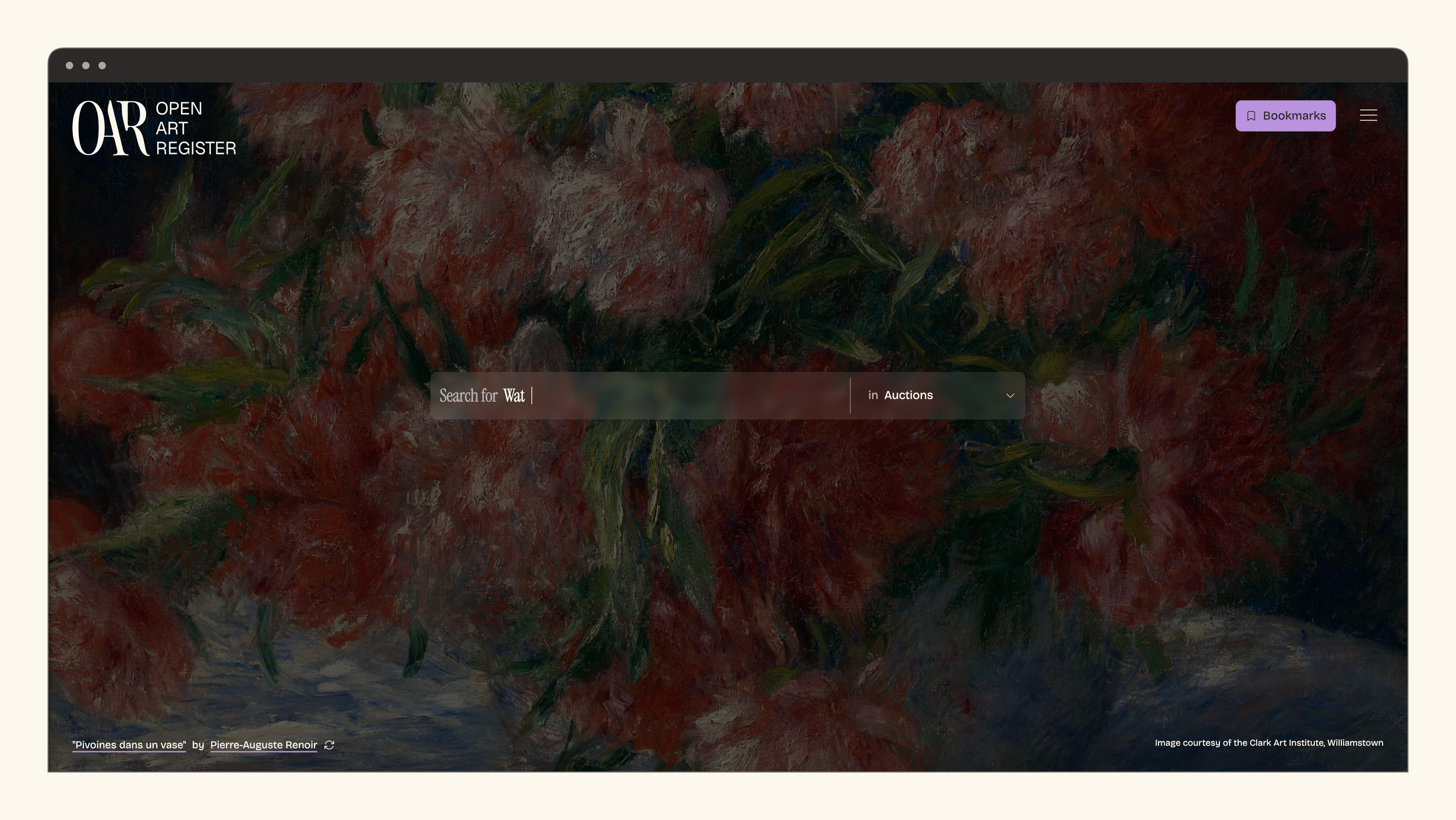
Images of the Open Art Register record the development process. They may not reflect accurate data or stay consistent until general release.
Navigating.art is thrilled to announce its development of the Open Art Register (OAR), a research infrastructure connecting information about artwork, exhibitions, auctions, publications, people, and organizations across institutional and scholarly sources. The first general-access version is planned for 2028.
The OAR addresses a persistent limitation of digital research resources: records may be individually accessible online while the relationships between them remain difficult to follow across systems. Different identifiers, data structures, and descriptive conventions mean that connections established within one collection or research project are not readily available elsewhere. Researchers must repeatedly identify corresponding records and reconstruct their relationships.
The OAR will bring together identifying information and relationships contributed by institutions and scholars, mapped to a common model, and connected through persistent identifiers. Each contribution will remain distinct, visibly attributed, and linked to the contributor’s own documentation and scholarship. Through the website, researchers will be able to search this information, follow relationships, and compare accounts from different sources. A single record can thus become a starting point for examining related evidence across collections and projects, with a clear route to the sources behind each connection.
Searching and following relationships
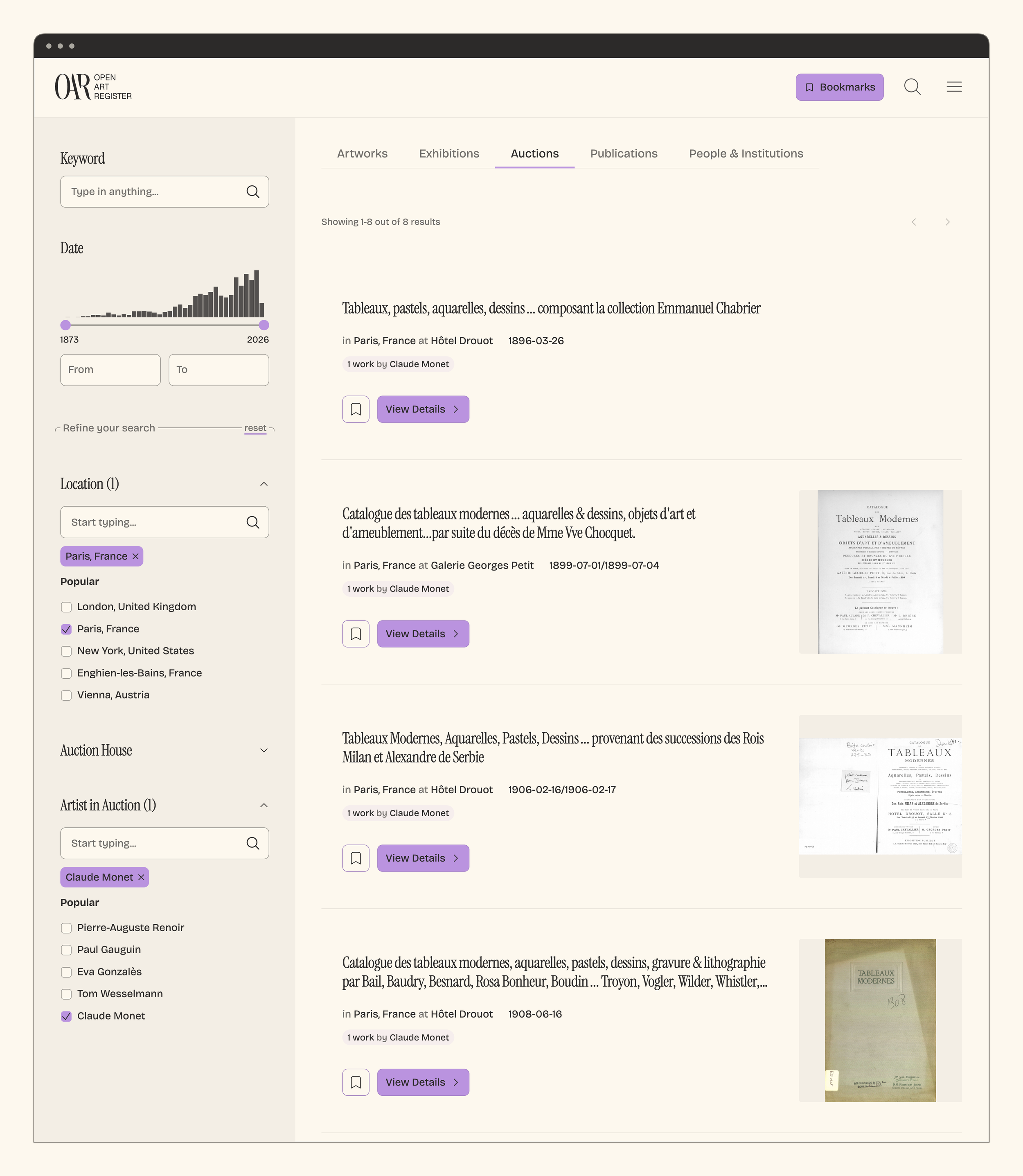
A researcher tracing Éva Gonzalès’s auction history can use the auction search to narrow results by artist, date, location, keyword, or auction house. Opening a result leads to an auction page that connects its identifying information with the artwork, organizations, and publications recorded in the contributed data. The search thus provides an entry into the documented relationships around a sale.
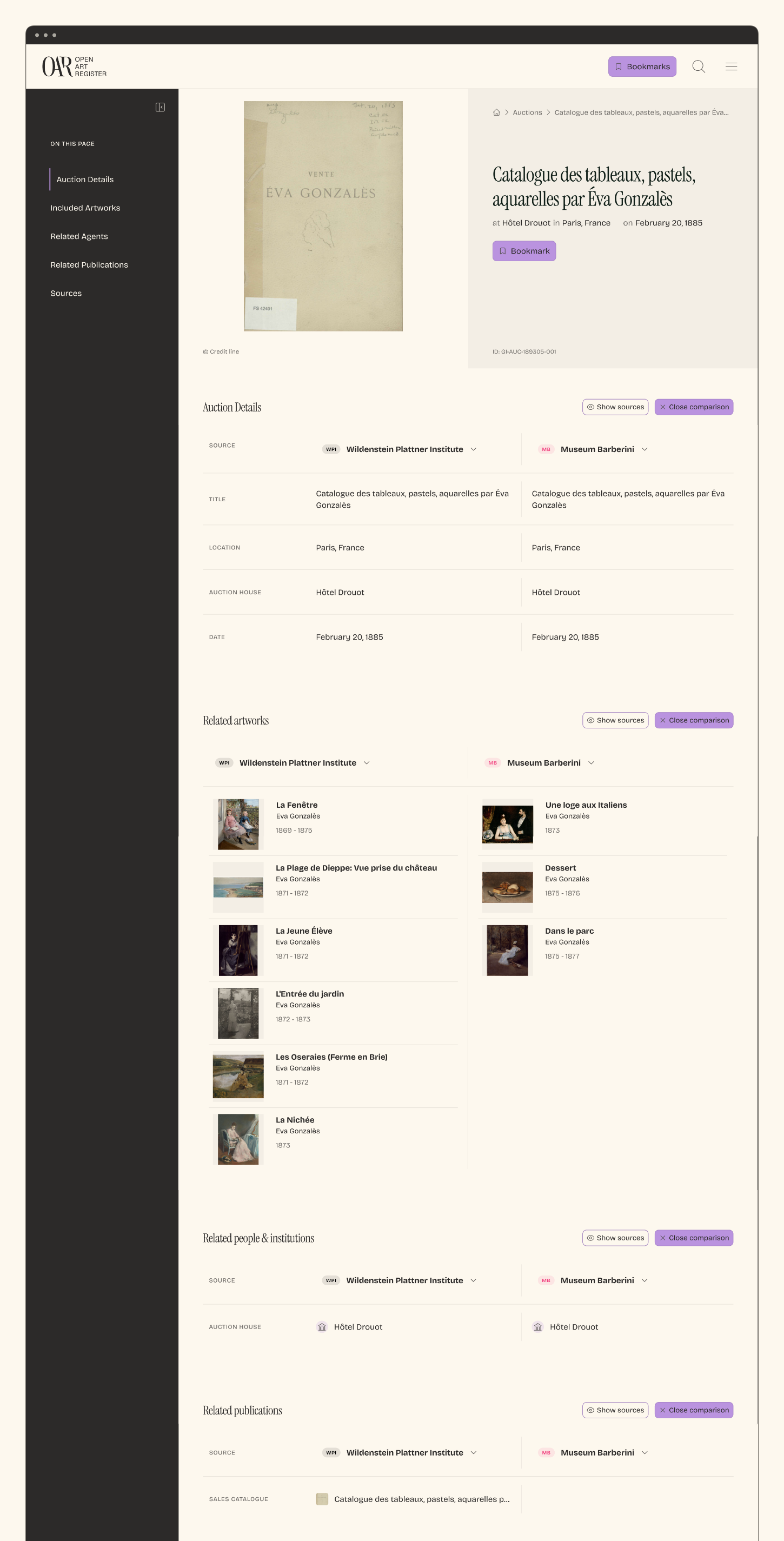
The sale held at Hôtel Drouot on 20 February 1885 provides a concrete example of this route. Listed as Catalogue des tableaux, pastels, aquarelles par Éva Gonzalès, its page brings together the sale’s date and location, related artwork, the auction house, and a reference to the sales catalogue. From this page, a researcher can open Gonzalès’s La Fenêtre and examine its recorded provenance, other auction appearances, exhibition history, and associated publications. Moving from the sale to the artwork brings these references together around a single identified work.
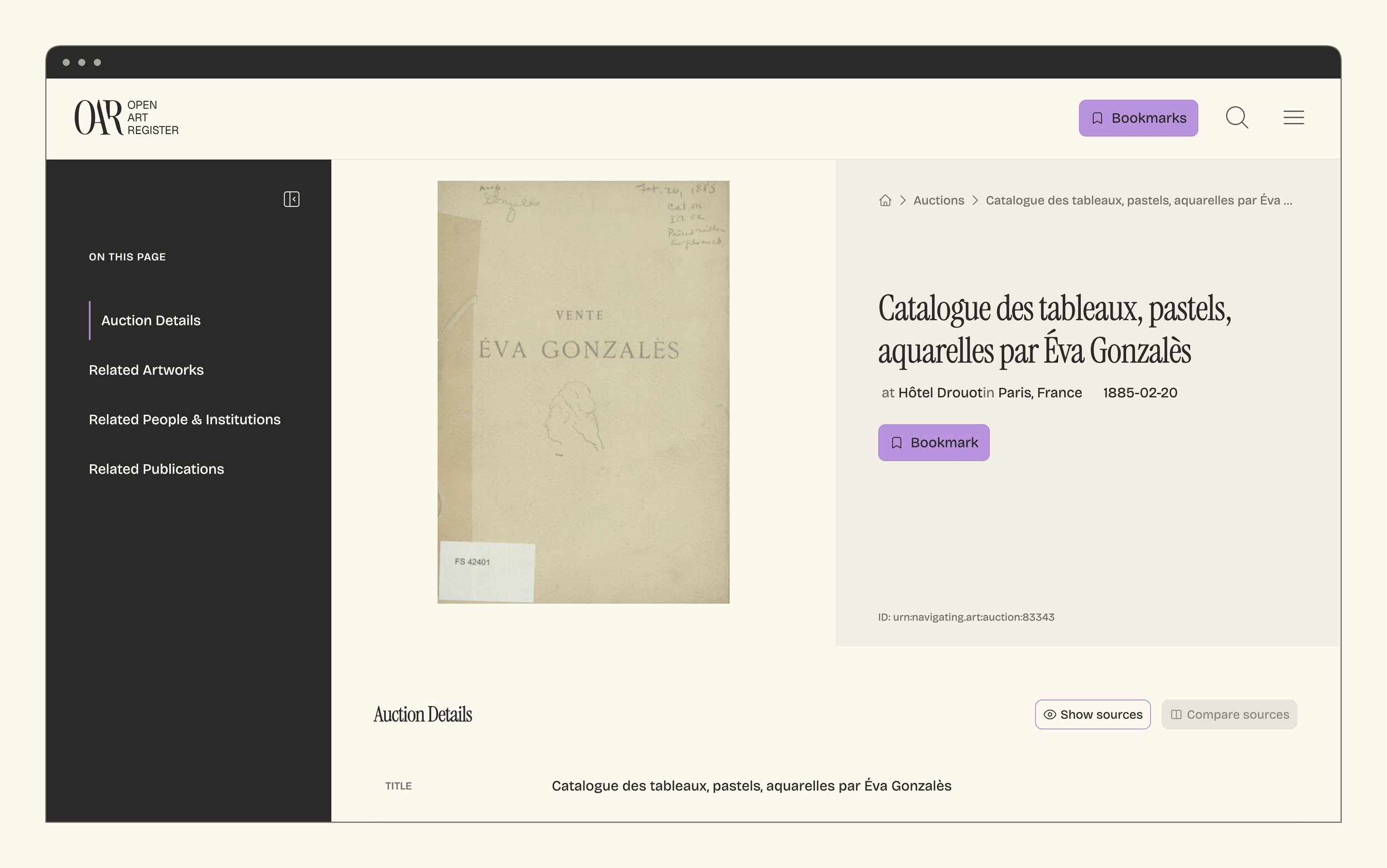
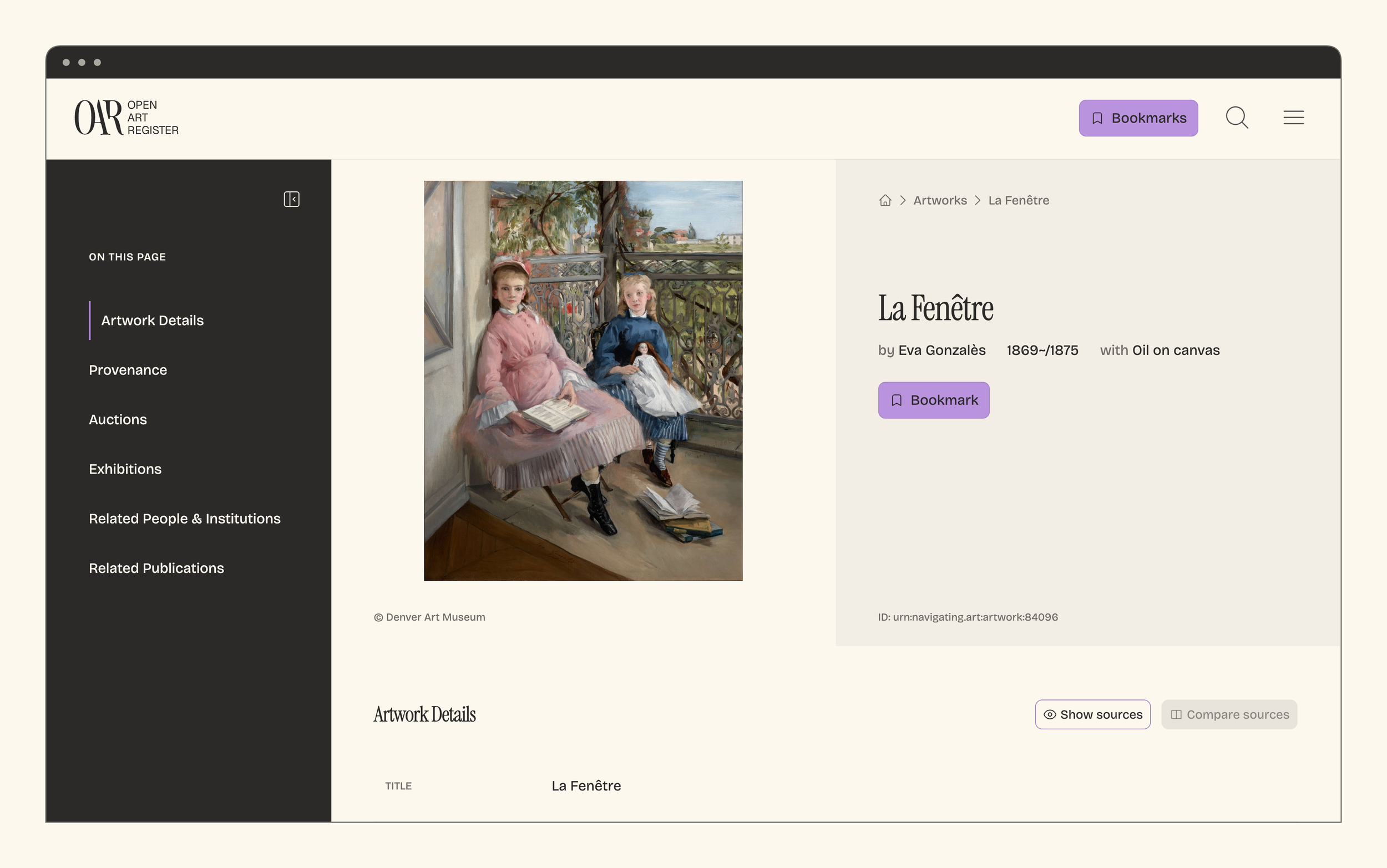
The La Fenêtre page also connects this history to a present-day collection record. A link to the Denver Art Museum’s online entry is automatically extracted from the provenance, giving the researcher access to documentation maintained by the museum. A research path beginning with a nineteenth-century auction can therefore lead to the museum’s current account of the work. Participation can thus bring an institution’s scholarship into research paths that begin elsewhere.
Planned research tools will help researchers carry such enquiries forward. Bookmarks will be available without an account, and research lists will be able to combine different types of record, with options to create, import, and export those lists. An enquiry beginning with the Drouot sale could thus bring together the auction, La Fenêtre, and selected exhibition or publication references for subsequent investigation.
Examining contributions and their sources
The same research path can be examined in terms of who supplied its information. Selecting “Show sources” reveals contributor labels alongside the displayed details and relationships. In the illustrated two-source auction record, the labels “MB” and “WPI” identify contributions from Museum Barberini and the Wildenstein Plattner Institute. These labels make the origin of the information visible as the researcher moves through the record.
A shared OAR identifier will make it possible to examine contributions about the same entity together. The identifier will refer to the registered subject—for example, the Drouot auction or La Fenêtre—while each institution’s description and recorded relationships remain distinct and attributed. As documentation develops, the information associated with that identifier can change without changing the reference itself. Researchers and projects will thus have a stable way to refer to the subject while examining the separate accounts that describe it.
The planned comparison tools will show where sources agree as well as where their accounts differ. A date or title can be compared at field level, while an artwork’s inclusion in an exhibition concerns a recorded relationship. The presence of two contributors on the illustrated auction page does not itself indicate disagreement. The OAR will preserve each contributing account without selecting a preferred version, allowing researchers to identify which details and connections warrant further examination.
Contributing and maintaining information
The intended contribution process combines technical support from the OAR team with review by the contributing institution or scholar. The team will assess the dataset and map the identifying information and relationships relevant to the register’s model. Contribution routes can include structured files such as CSV or Excel, as well as connections with institutional systems where supported. Contributors will review the mapped information and proposed matches before publication, giving them an opportunity to examine how their documentation will be represented and connected. Institutions can therefore participate from their existing systems without adopting the Navigating.art platform.
Contributors will retain control of their information after publication. The planned contributor interface will allow authorized users to submit, review, edit, and monitor their contributions, with additional update routes being developed to accommodate different institutional workflows. These tools are intended to give institutional teams a direct, understandable way to maintain their contributions as documentation and research develop.
Development shaped by scholarly practice
The OAR’s development draws on Navigating.art’s ongoing work with teams producing digital catalogues raisonnés and archives, such as the Wildenstein Plattner Institute, whose data appears in the prototype images, alongside discussions with prospective contributors. Scholars and museum professionals have emphasized the importance of a clear, direct relationship with the data they contribute. That feedback has made the contributor interface a particular development priority, connecting the practical requirements of institutional teams to decisions about how the register is built.
The current prototype, supported by data from the Wildenstein Plattner Institute and Museum Barberini, provides a basis for examining the intended research workflow. Work ahead includes refining relationship mapping and source attribution, testing research and contribution processes, and defining governance and access arrangements, including licensing and methods for dataset reuse. With the first general-access version planned for 2028, this development period offers an opportunity to assess these decisions with the institutions and scholars who will contribute to and use the register.
Institutions and scholars considering a contribution are invited to discuss a representative dataset with the OAR team. The conversation can examine which information fits the model, how it would be mapped and attributed, where source links would lead, and how updates could be maintained. For teams already in discussion with Navigating.art, this offers a concrete next step toward assessing the technical fit, expected staff involvement, and research value of participation.