
A NAVIGATING.ART INITIATIVE
The Open Art Register
Making art-historical information easier to find, connect, compare, and trace to its sources.
A museum may hold the collection record for an artwork while its exhibitions, auction appearances, publications, and related people are documented elsewhere. Following that evidence takes time, and the differences between sources may be as important as what they share.
The Open Art Register makes those relationships easier to find and assess. It gives each registered subject a stable identifier, connects identifying sets of information, and guides researchers back to full records on the contributing institution’s website.
IN DEVELOPMENT. Working prototype available for demonstrations with general access planned for mid-2028
How the Open Art Register works
From source records to connected research
The Open Art Register is being developed to connect art-historical information while preserving attribution and links to its sources.
Mapped by the OAR team and reviewed by contributors
Open Art Register
Stable identifiers connect records concerning the same subject. Contributions remain distinct and credited as relationships are traced across sources.
- Explore relationships Follow connections across collections and research projects.
- Compare contributions Examine different accounts with their sources identified.
- Visit source records Follow prominent links to contributors’ own websites.
Ensuring contributions stay up to date
Contributors stay in control of their contributions. A planned interface will allow authorized users to review, edit, and monitor their data. Different update routes are being developed to accommodate existing institutional workflows.
Connecting records across sources
Institutions and scholars contribute information that identifies artwork, exhibitions, auctions, publications, people, and organizations, and describes relationships between them.
The OAR team maps this information to a common model, and contributors review the mapped information and proposed matches before publication. Each registered subject receives a persistent OAR identifier—a stable reference that helps connect information about the same subject across sources.
Keeping information connected to its source
Each contribution remains distinct and visibly credited. Researchers can follow relationships and compare descriptions while seeing which institution or scholar supplied the information.
Prominent links direct researchers to the contributor’s own website, where they can explore source records, interpretation, and scholarship. Different accounts remain available for comparison, preserving the perspectives of the institutions and scholars behind them.
Work with your existing systems
You can contribute to the OAR while continuing to use your existing systems. Using the Navigating.art platform is not a requirement for participation.
What the Open Art Register makes possible
The OAR is being developed to help researchers follow connections, examine different accounts, and reach the sources behind them.
-
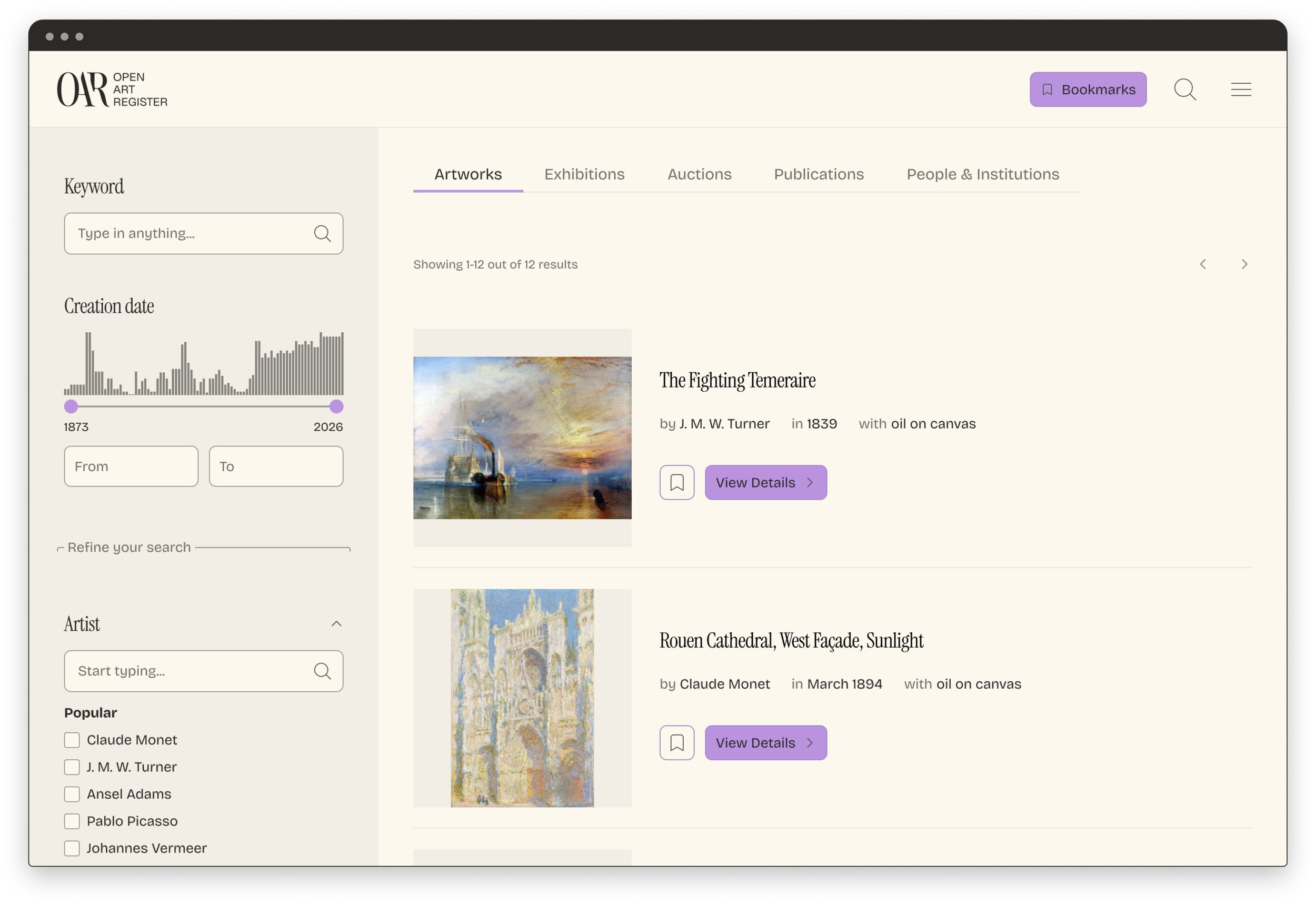
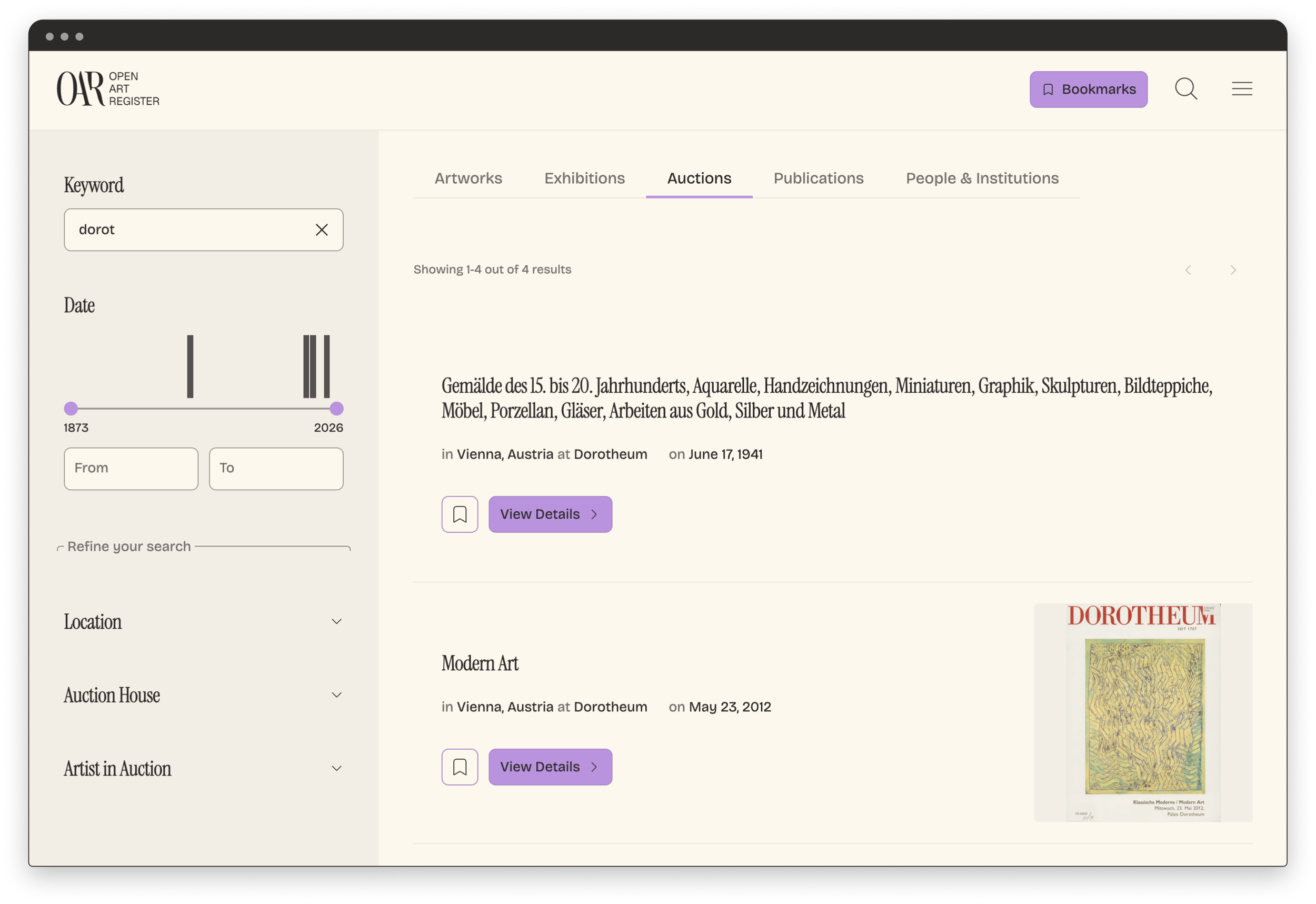
Search across five connected record types: artwork, exhibition, auction, publication, and agent. In the OAR, an agent is a person or organization.
-
See who supplied each contribution and follow a direct link to their website. Explore the institution’s or scholar’s own records, interpretation, and publications.
-
Compare descriptions and relationships from different sources. Differences remain visible, allowing you to consider the evidence and documentation practices behind each account.
-
Use persistent OAR identifiers as stable references for artwork, events, publications, people, and organizations across research notes and collaborative projects.
Built for research and contribution
The OAR supports the people using art-historical records and the institutions and scholars making them available.
For researchers
Begin with a research question and follow evidence across different kinds of records. Compare where sources agree and differ, return to the scholarship behind each contribution, and use stable references across notes, publications, and collaborative projects.
The OAR is intended to make finding and comparing information easier while supporting your assessment of evidence and interpretation.
Discover related information across separate resources.
See who contributed each account and visit its source.
Compare descriptions and relationships side by side.
Use stable references to identify subjects across your research.
Organize research through planned bookmarks and lists.
For contributing institutions
Make your institution’s documentation discoverable in relation to records and scholarship held elsewhere. Each contribution stays visibly credited, with prominent links inviting researchers to visit your own website.
Your team reviews how its information is represented and retains control of its contributions. A planned contributor interface will provide a direct way to review and update data, alongside other update routes being developed.
Give researchers a clear path to your website and source records.
Retain attribution and responsibility for your contributions.
Review mapped information and proposed matches before publication.
Keep contributions current through an update interface and supported workflows.
Participate while continuing to use your existing systems.
We will discuss staff involvement, technical requirements, update methods, licensing, and governance with potential contributors as these arrangements are defined.
CONTRIBUTION
Help shape the Open Art Register
We are speaking with museums, archives, research institutes, foundations, catalogue raisonné projects, and individual scholars about potential contributions and research needs. These conversations help us understand what participation must support—from directing researchers to your website to keeping your information up to date.
If we have already discussed a contribution with your institution, we welcome the opportunity to continue with a representative dataset, your team’s update needs, or questions about how your contribution would appear.
The contribution process: From your records to connected research
Four steps connect information to both a stable OAR reference and the institution or scholar that described it.
Discuss your contribution
Speak with Navigating.art about your collection or research project, the information you maintain, and your goals for participating. Together, we can assess the dataset and discuss staff involvement and suitable ways to contribute.
Map and review
The OAR team maps your information to the register’s model and proposes matches with existing entities. Your team reviews the mapped information and proposed matches before publication.
Connect and credit
Registered subjects receive stable OAR identifiers. Your contributions remain distinct and credited, with links directing researchers to your website and source documentation. Relationships connect your information with relevant contributions from other sources.
Maintain your contribution
Your team stays in control of its contributed information. A planned interface will allow authorized users to review and make updates. Additional update routes and support arrangements are being developed to fit different institutional workflows.
Developing the OAR together
The first general-access version is planned for mid-2028. Research and contribution workflows, governance, and access and reuse arrangements are still being developed.
We invite people who know Navigating.art and our partner projects Networks of Impressionism and WPI's digital projects to short interviews. Leave your details here and we will get in touch when a session matches your interests.