
Led by Museum Barberini and developed in collaboration with Navigating.art and the Wildenstein Plattner Institute, Networks of Impressionism is now available free to use at networksofimpressionism.org. Enabled by the Hasso Plattner Foundation, the digital art history project begins with 115 works in the Hasso Plattner Collection and follows the people, institutions, exhibitions, publications, transactions, places, and sources that connect them to the wider history of French Impressionism. A timeline, map, and Data Explorer offer three ways to investigate those connections, while detailed records keep the evidence and its qualifications in view.
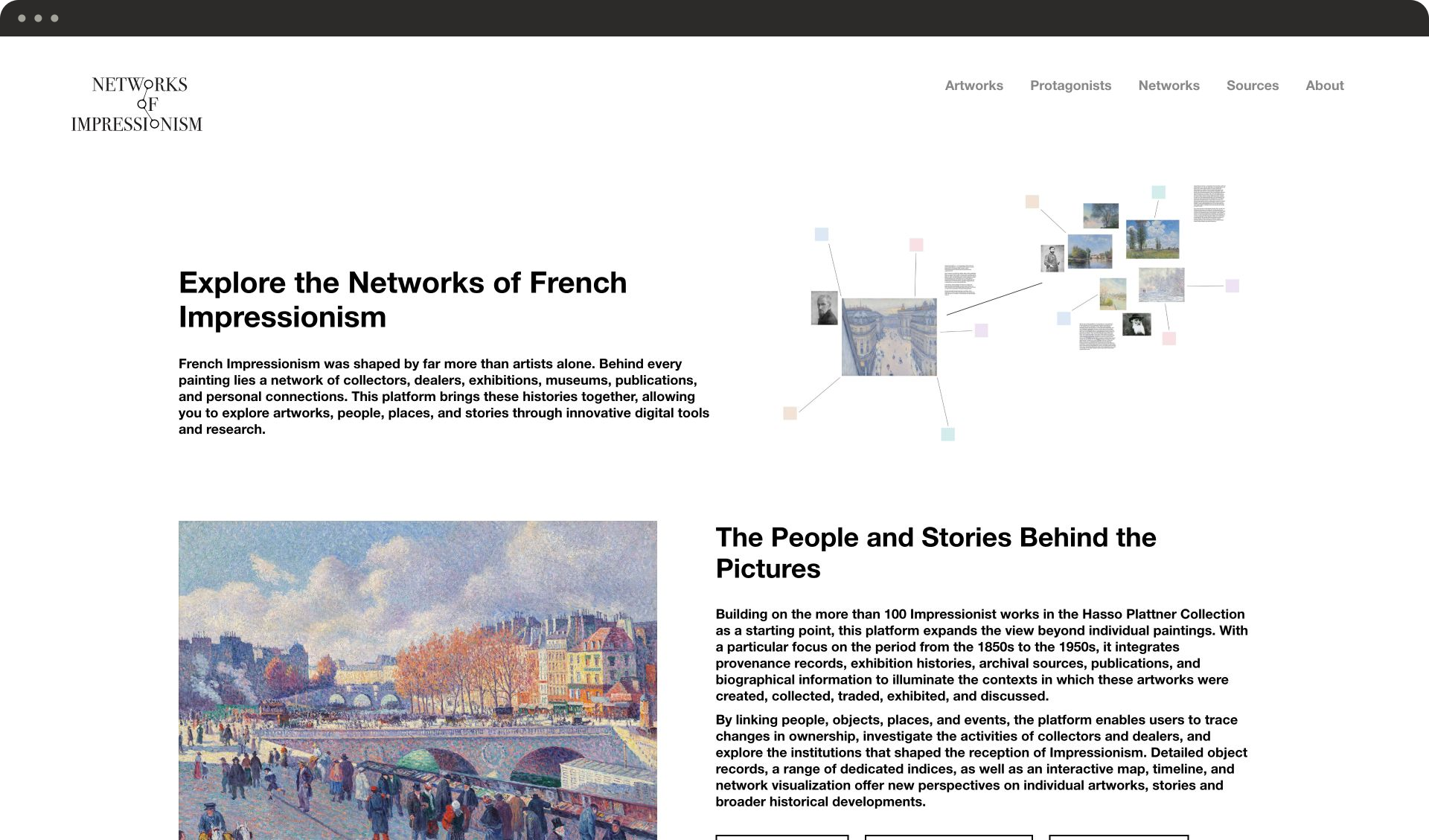
The collaboration brings together forms of knowledge that no partner could have supplied alone. Museum Barberini initiated and led the research development, using its work on the Hasso Plattner Collection to define the project’s questions. The Wildenstein Plattner Institute contributed catalogue raisonné scholarship, archival holdings, and digitized primary sources. Navigating.art contributed an established research platform and worked with researchers to expand it for the project. The Navigating.art team developed the research environment alongside the scholarship, making shared decisions about what evidence matters, how it should be represented, and how researchers should encounter it.
A small corpus can produce a surprisingly large field of evidence. Provenance research into the 115 works alone has identified 382 people and institutions and 1,042 known transactions within their histories. Each record introduces further dates, places, roles, sources, and degrees of certainty. Networks of Impressionism shows how an established scholarly infrastructure can be extended around a specific research initiative, making this dense body of evidence easier to explore without flattening the distinctions on which art-historical interpretation depends.
A research initiative shaped through collaboration
Museum Barberini began with a set of historical questions. When did the events surrounding the paintings occur? Where did artists, collectors, dealers, exhibitions, and institutions intersect? How were people, artwork, publications, and events related? These questions grew from the museum’s research on the Hasso Plattner Collection and from the broader inquiry into the networks through which Impressionism developed between the 1850s and the 1950s.
The Navigating.art team treated these questions as a common point of departure. It collected and tagged them, then mapped them to the records and relationships already represented in the Navigating.art platform. Chronological questions required more thorough dating across all types of events and qualifications to describe circumstances. Geographical questions required places to stay identifiable across different kinds of events as well as specification to categorize activities taking place there. Relational questions required the project to show not only that two records were connected, but also what kind of connection the evidence supported.
Extending an established scholarly foundation
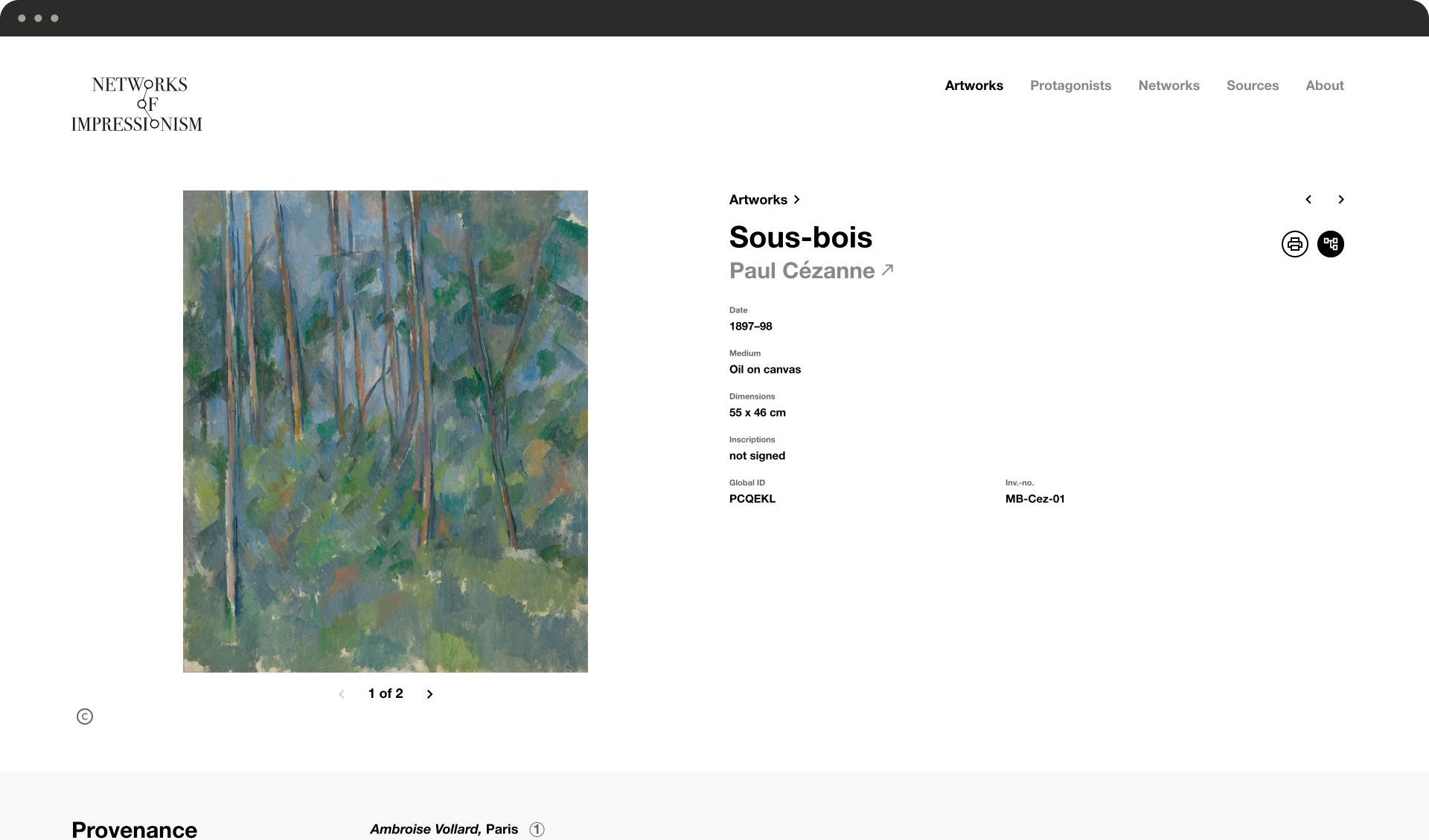
Networks of Impressionism extends a data model already developed with art researchers around the requirements of catalogue raisonné scholarship. That model connected artwork with people and institutions, provenance, exhibitions, publications, archival materials, sources, and qualified research statements. For Networks of Impressionism, Navigating.art extended it to include physical marks and relationships among people and institutions, then developed the timeline, map, and Data Explorer specifically for the project.
This established model addressed a central difficulty of cataloguing artwork. Identifying a painting across historical sources may demand much more than matching a title. Researchers may need to compare dimensions, owners, dealers, exhibitions, inscriptions, archival photographs, and physical marks before they can determine which work a record describes.
That challenge is especially acute for Impressionism. Artists often returned to the same motifs and produced paintings with similar titles, subjects, and dimensions. Historical documents may describe a work briefly, reproduce it only in black and white, or use a title that later changed. A reliable digital record must therefore hold different kinds of evidence together while allowing researchers to see which source supports each statement and how certain the conclusion is.
Paul Cézanne’s Sous-bois provides a compact example of the project’s work with marks. Among the 1,777 black-and-white photographs in WPI’s Galerie Étienne Bignou Photo Archive is an image of the painting with the inventory number B 2704 on its reverse. The same number appears on a label attached to the painting’s stretcher. A provenance annotation links to the corresponding photograph in WPI’s digital archive, while the painting’s mark record documents the related label.
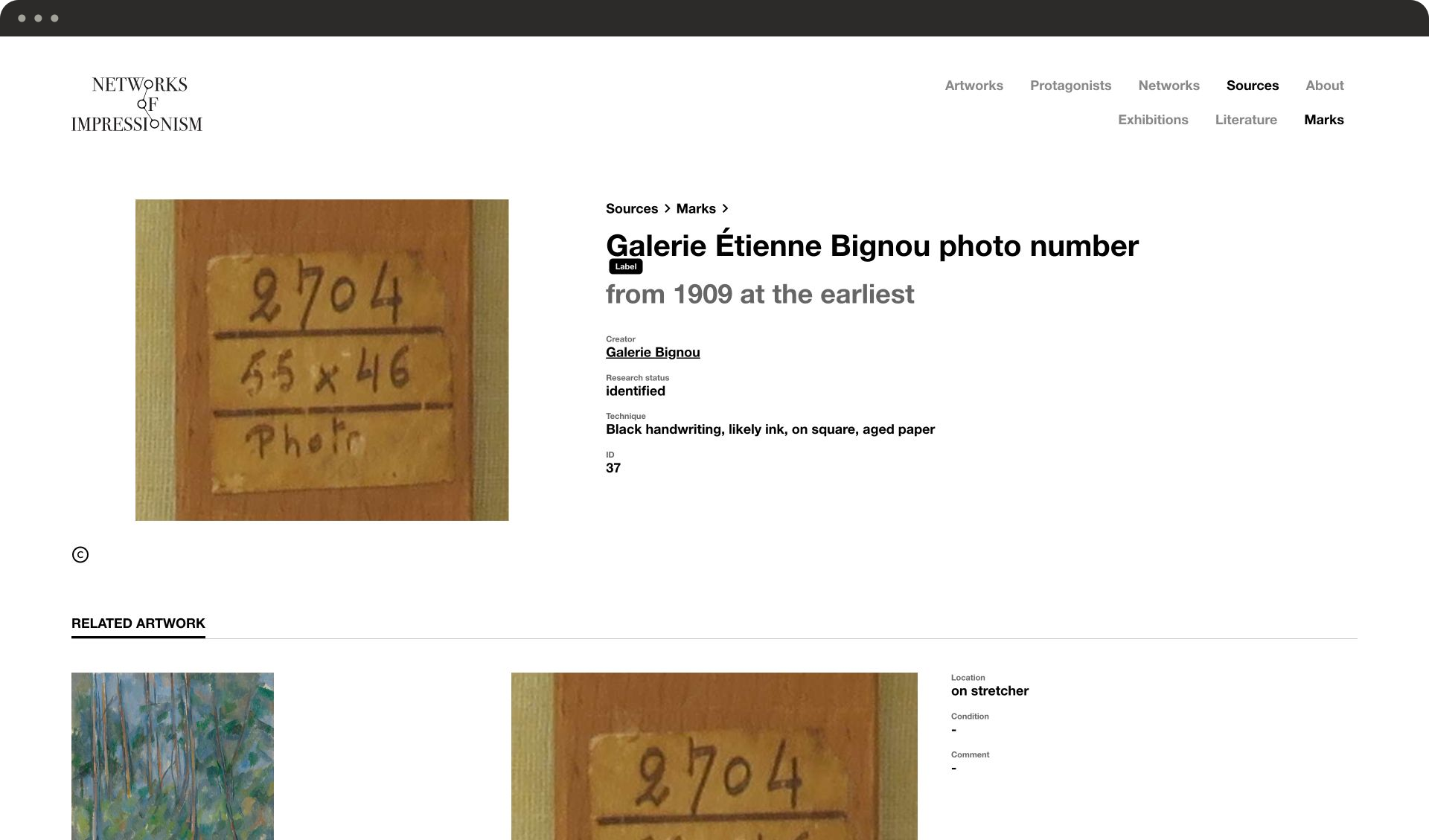
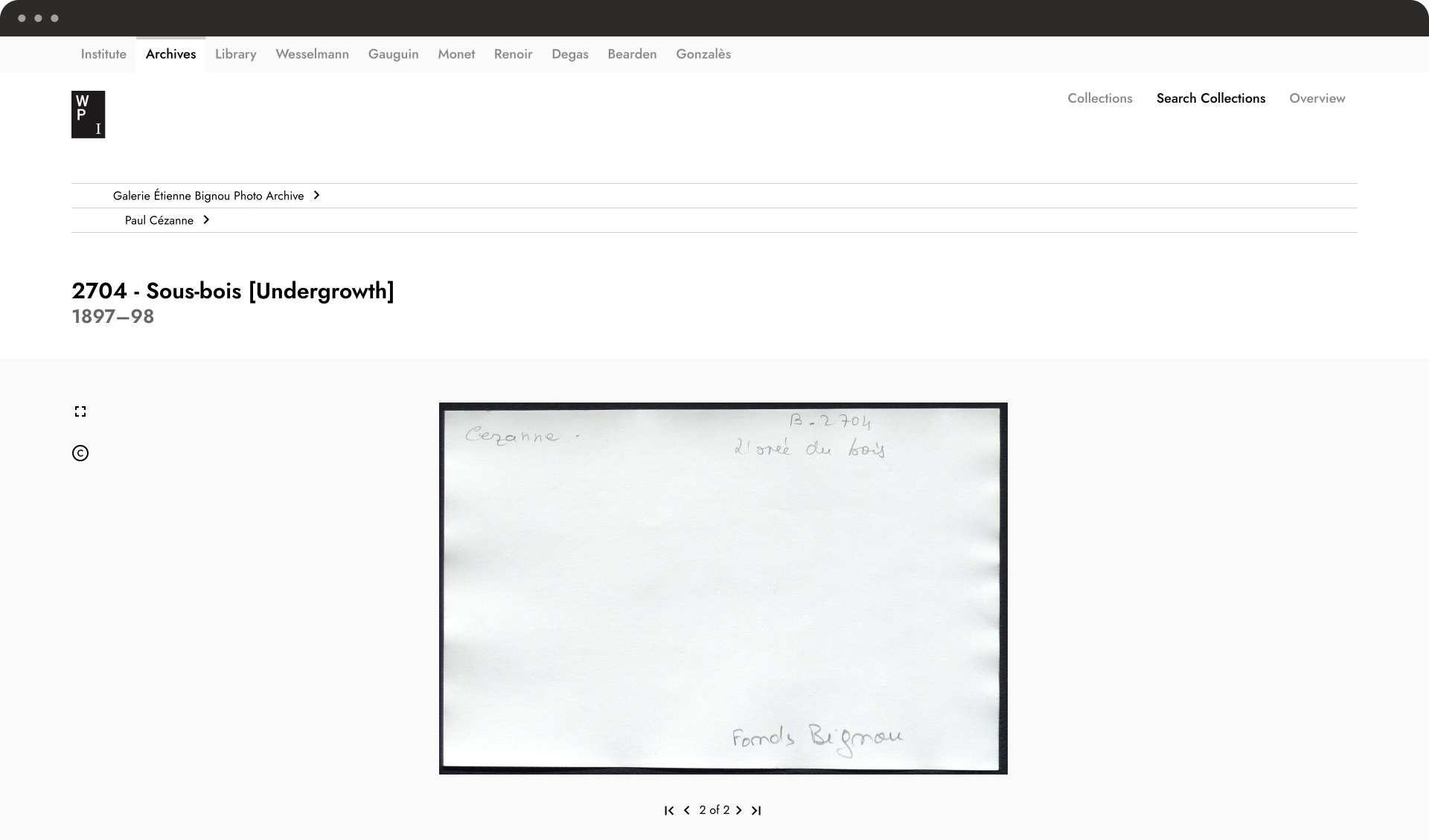
By representing the label and its inventory number within a structured mark record, the platform gives a small material trace a precise place in the research. It connects the mark to the painting and the relevant gallery while preserving the status of the attribution. The number can support investigation wherever it becomes relevant without a probable conclusion gradually hardening into fact.
Three interfaces for three forms of inquiry
The Data Explorer, timeline, and map reorganize the same structured research through relationship, time, and place. Because they draw on shared records, researchers can change the scale and direction of an inquiry while retaining a route to the underlying evidence.
In the Data Explorer, a user begins with a node representing an artwork, person, institution, exhibition, auction, or publication. The user then chooses which connection to open and expands the network one node at a time. This incremental design keeps the researcher’s decisions visible and makes the type and direction of a relationship legible. The resulting view records a selected path through the evidence and shows how the inquiry developed.
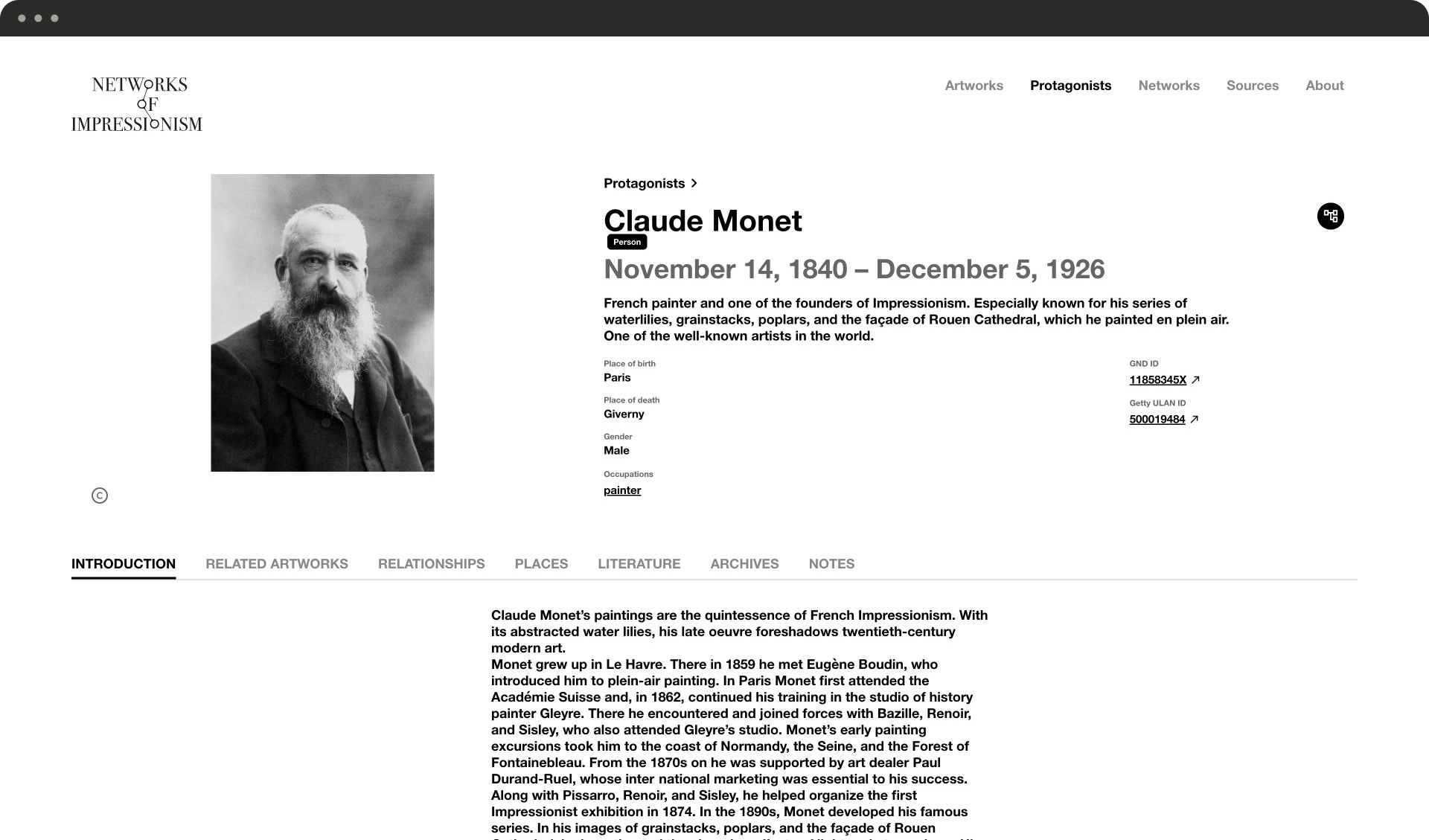
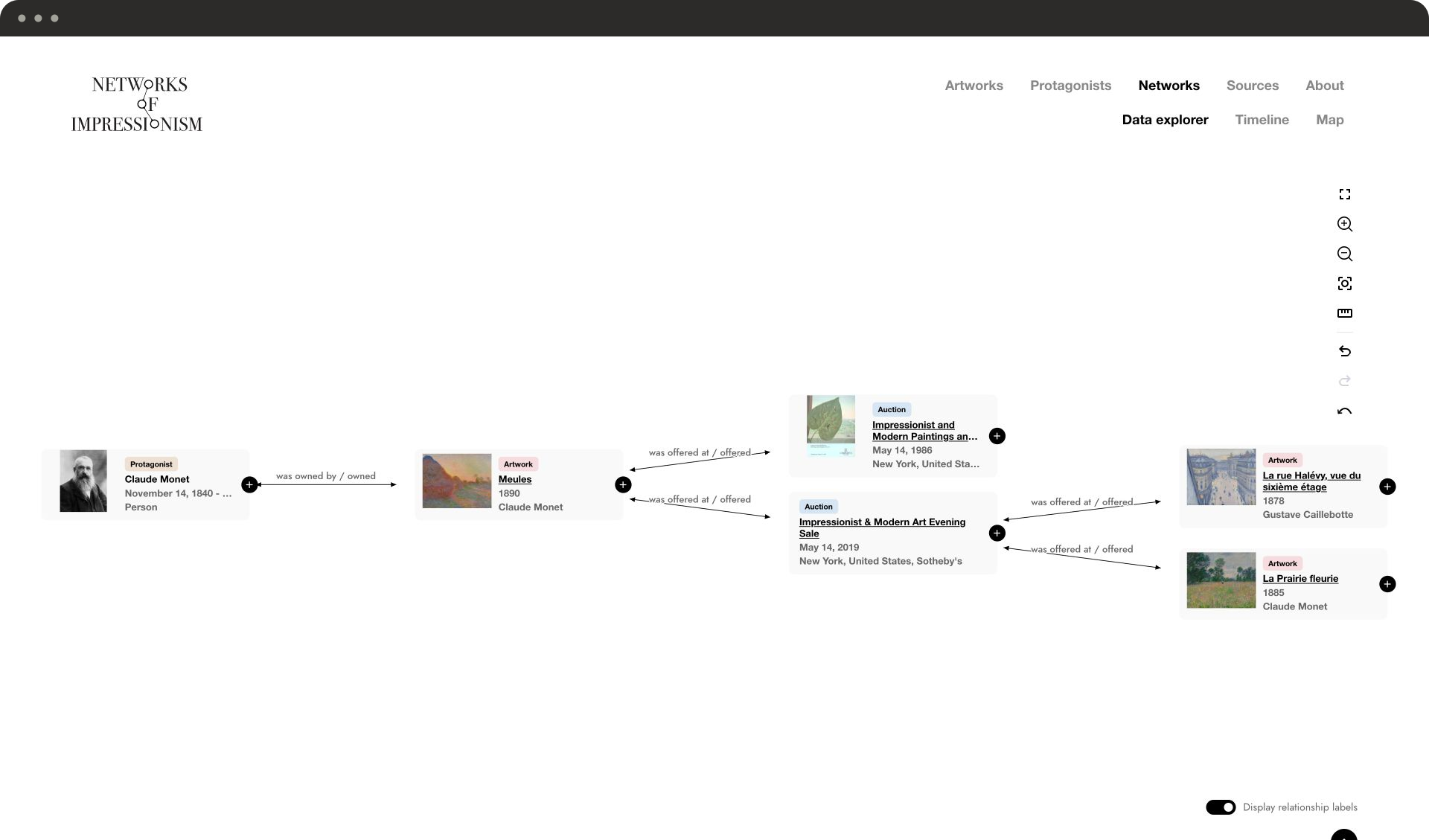
Beginning with Claude Monet, a researcher can expand the interface relationship labeled “Artwork” to bring Meules (1890), “created by / created,” now part of the Hasso Plattner Collection, into the graph. From the painting’s node, the researcher can select Auction, which reveals two moments in the painting’s market history: a Christie’s auction in New York on May 14, 1986, and a Sotheby’s auction in the same city on May 14, 2019, exactly thirty-three years later. Opening the “Artwork” option on the 2019 sale as a node then reveals other work offered at the same event, including Gustave Caillebotte’s La rue Halévy, vue du sixième étage (1878). The resulting path does not imply a direct historical relationship between the Monet and Caillebotte paintings. Instead, it identifies the later market event through which they became connected.
By preserving the type and direction of each relationship, the Data Explorer allows an inquiry to move from artistic production to repeated market circulation and then to the composition of a particular auction without treating those different forms of connection as equivalent.
An integrated timeline
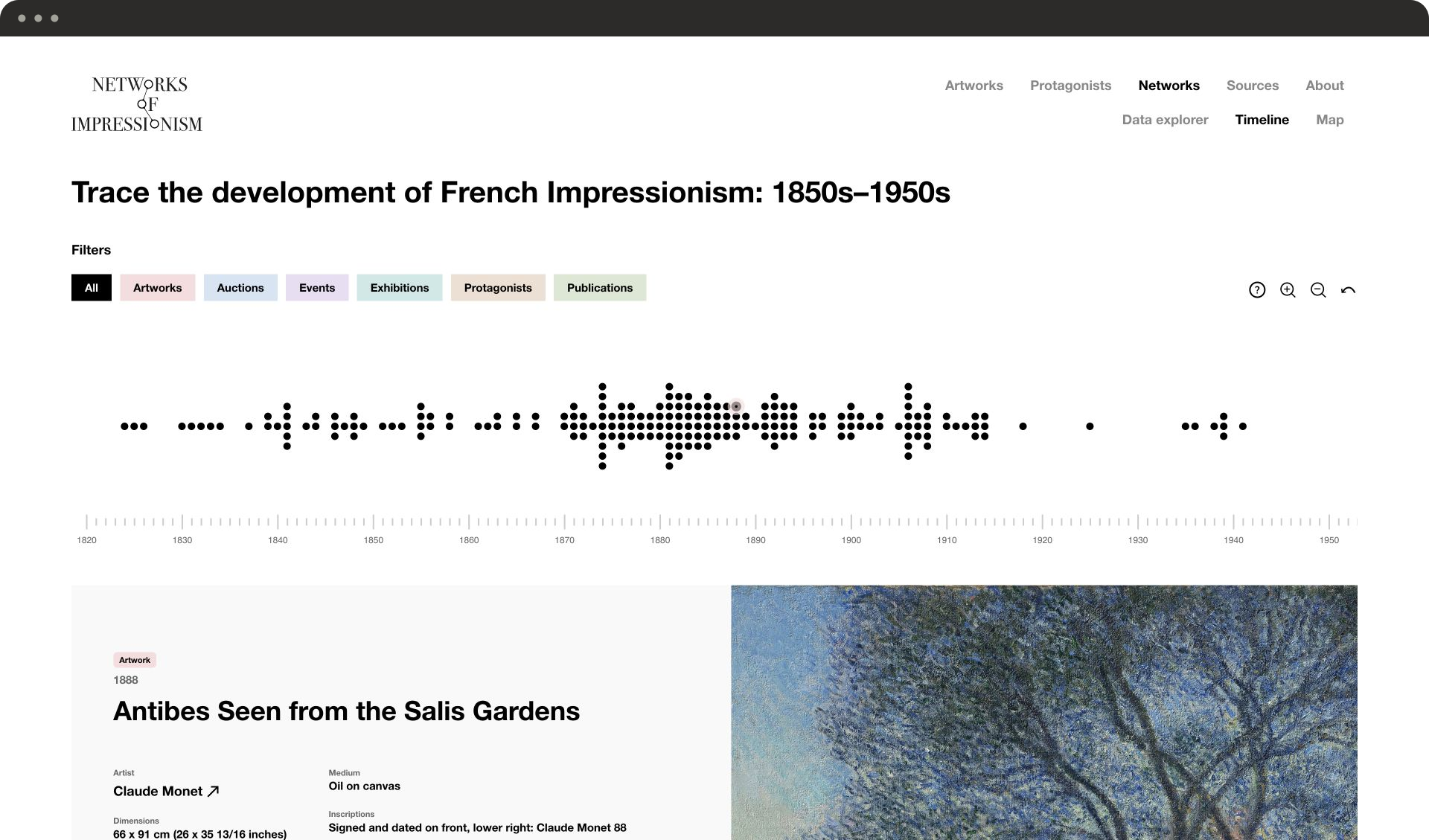
The timeline places selected artwork, auctions, exhibitions, historical events, protagonists, and literature in chronological relation. Researchers can filter the entries, change the temporal scale, and open the detailed records behind individual points. An entry for Georges Petit’s purchase of land in Paris in 1888 for a new headquarters, for example, places the development of art-world infrastructure alongside events associated with artists, exhibitions, and the market. The timeline lets researchers notice simultaneities, recurrences, and changes in activity that remain difficult to perceive when biographies, exhibition histories, and publications are consulted separately.
Mapping impressionism
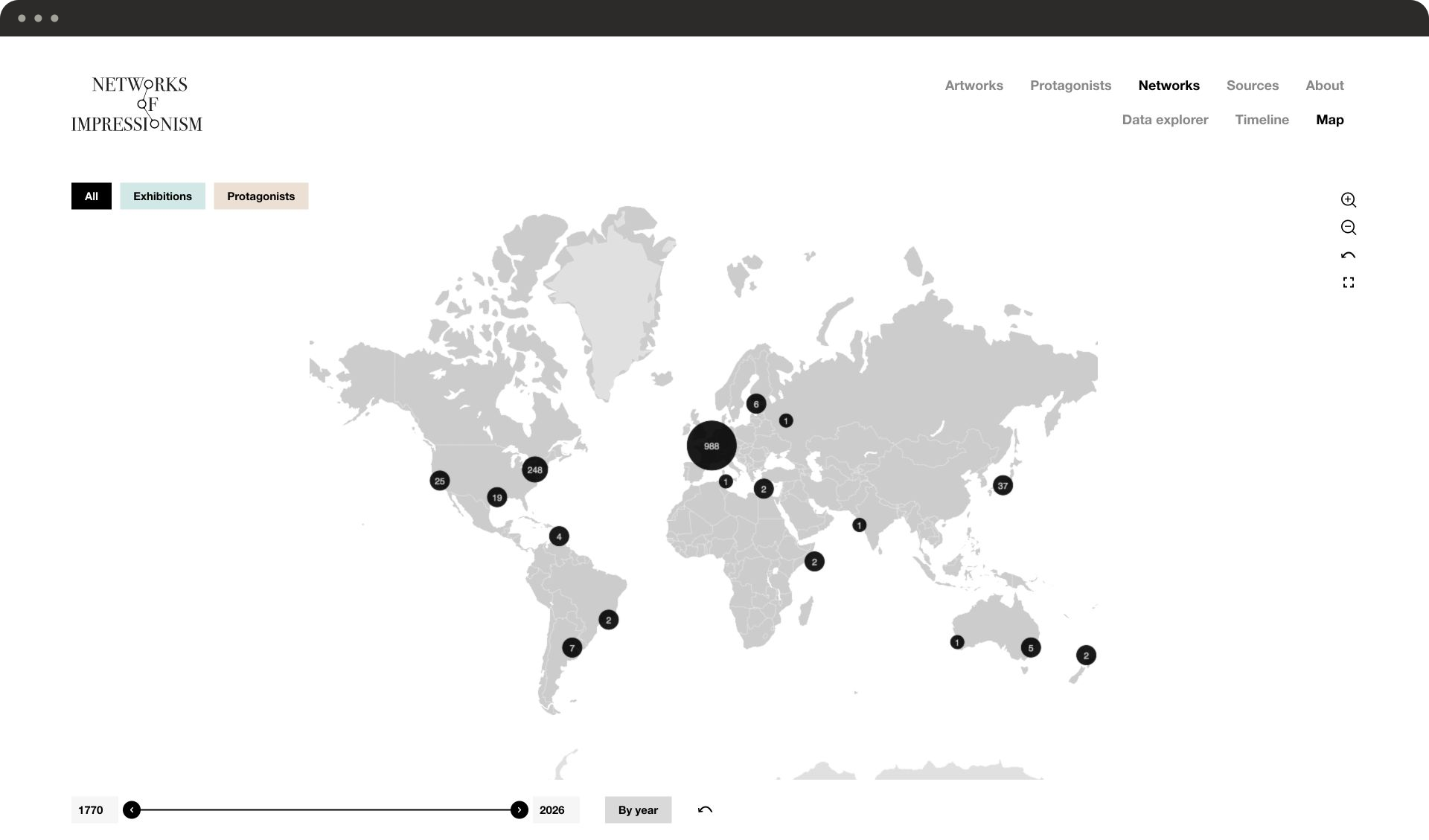
The map offers a corresponding geographical view. It organizes documented locations associated with the project’s people, institutions, and exhibitions. Its date filter and year-by-year setting make it possible to follow how clusters of activity emerge, spread, or grow over time. Galleries, auction houses, exhibition venues, museums, and private addresses can therefore be studied as parts of the social and institutional history through which Impressionism circulated.
Recent digital humanities scholarship treats chronology and geography as methods of inquiry rather than as illustrations added after an argument is complete. In digital art history, mapping has supported spatial, global, and social histories by relating the circulation of artwork to the activities of people and institutions. Research on historical networks has likewise shown the value of considering temporal and geographical patterns together. Networks of Impressionism brings these approaches into the same research environment, allowing a pattern seen in one interface to be investigated through another.
From a visible pattern to a research question
Researchers can use these interfaces to turn a visible connection into a research question. The record for Gustave Caillebotte’s Le Pont d’Argenteuil et la Seine, for example, points to the relevant page in Marie Berhaut’s 1994 catalogue raisonné. The cited passage is highlighted, making it possible to move directly from the project’s record to the scholarship that supports it.
The same catalogue raisonné identifies another work in the collection, Chemin montant. Following that painting leads to the Seventh Impressionist Exhibition, where it appeared with three other works now represented in Networks of Impressionism. The exhibition record brings those paintings together with its venue and dates and with a digitized copy of the historical catalogue. A path that begins with one work can thus move through catalogue raisonné scholarship to another painting, a shared exhibition, and a primary source.
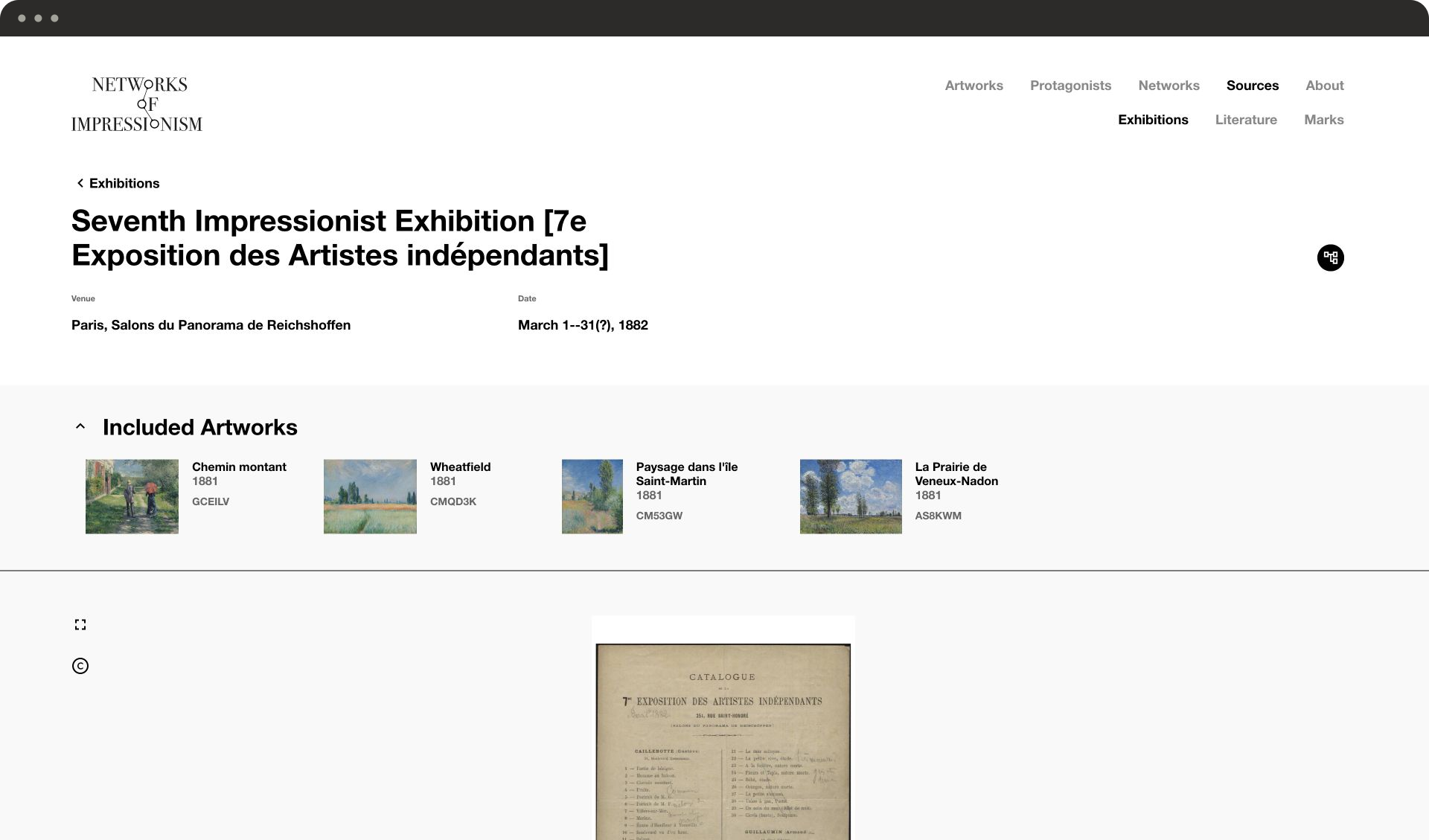
Because the artists organized the Impressionist exhibitions themselves, participation in the same event provides meaningful evidence of shared activity. It creates grounds for asking whether the artists knew or encountered one another and how their works were presented within the same setting. The interface does not need to resolve that question in advance. Its role is to make the connection visible, show what kind of relationship has been documented, and provide the records needed to test an interpretation.
The exhibition date also shows why qualifications must remain attached to the data. It appears as “March 1–31(?), 1882,” preserving the question surrounding the closing date. Comparable records may include approximate dates, unidentified owners, or qualified statements such as “probably acquired.” When these details enter a visualization, their appearance can seem more conclusive than the underlying evidence. By keeping a path back to the record and its source, Networks of Impressionism lets researchers use patterns as the beginning of an inquiry rather than as substitutes for one.
An established foundation, expanded together
Networks of Impressionism demonstrates what becomes possible when institutional research, archival and catalogue raisonné scholarship, and established digital infrastructure develop in conversation. The collaboration directed project-specific development toward the points where it could change what researchers are able to investigate: physical marks, relationships among people and institutions, and relational, chronological, and geographical views across the research.
The partners are already meeting with museums about adding further institutional collections and research. Expansion will introduce new evidence and new points of connection, but the principle established by the first 115 works will remain central: a larger network becomes useful only when the records within it retain their identities, sources, relationships, and scholarly qualifications.
Networks of Impressionism launched on November 6, 2026, and is freely accessible at networksofimpressionism.org.
The digital project inspired the topic of the Museum Barberini’s tenth anniversary exhibition The Impressionists: Monet, Morisot, Renoir, and their Network. Organized for the museum’s tenth anniversary, the exhibition examines the artists, writers, patrons, collectors, buyers, dealers, exhibitions, and galleries that contributed to the international development of Impressionism. It is on view from November 7, 2026, through February 21, 2027. Together, the exhibition and digital project offer complementary ways to examine the people, institutions, and exchanges through which Impressionism developed.