The first published installment of the Eva Gonzalès Digital Catalogue Raisonne Project has been released by the Wildenstein Plattner Institute. It’s an important contribution to scholarship on nineteenth-century art, helping to restore a significant painter to her rightful place in the historical canon. During her life, Eva Gonzalès (1847 - 1883) skillfully painted nearly two hundred works depicting modern life from the vantage point of a female artist. Her talents were acknowledged by her teacher, Édouard Manet, along with dealers, critics, and collectors, making her influential in artistic circles and the art market. This publication brings together her paintings, pastels, drawings, watercolors, and sketchbooks and their histories for a global audience.
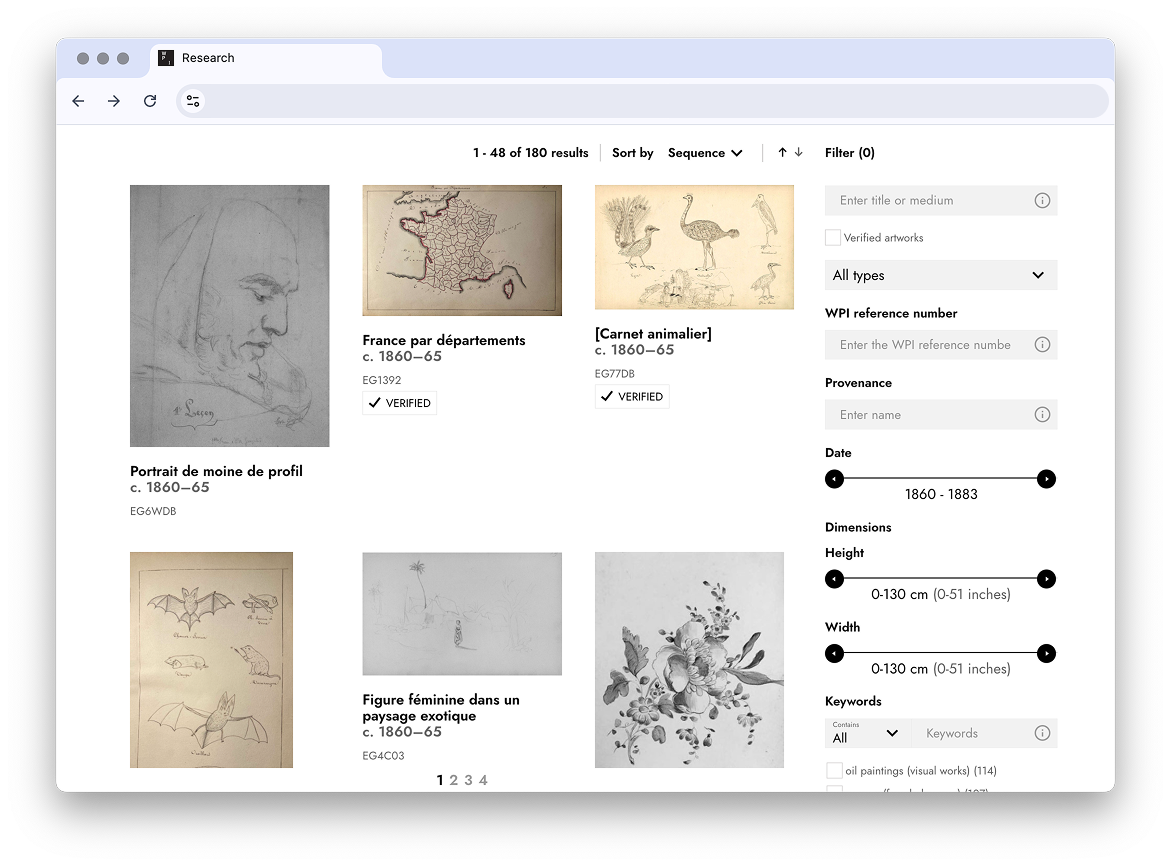
Eva Gonzalès Digital Catalogue Raisonné is a major update of the 1990 Gonzalès Catalogue Raisonné published by La Bibliothèque des Arts (Paris). Marie-Caroline Sansaulieu, a co-author of the original publication, partnered with Sophie Pietri, head of archives at the Fonds WPI in Paris, to lead the reexamination of each work and include the most accurate and current information. It also includes material never before accessible to scholars. Most notably, the catalogue raisonné now incorporates Gonzalès's sketchbooks, which offer insight into her working methods, artistic development, and intellectual formation. Additionally, images of a number of works catalogued in this publication have never been reproduced publicly.
This is the first digital catalogue raisonné dedicated to a female artist released by the WPI, and it meaningfully expands the WPI’s growing body of scholarship on mid-nineteenth-century French painting. By bringing together both newly surfaced material and comprehensive documentation of works that remain unlocated, this publication establishes the most complete account of Gonzalès's artistic production to date, while also signaling the areas where further research and discovery remain possible.
Eva Gonzalès: Training, mentorship, and artistic independence
Eva Gonzalès's development as an artist was shaped by privilege, rigorous training, and a determination to move beyond the conventions of her instruction. She came from an erudite family that valued education, which is evident already in the earliest materials in the catalogue raisonné. Her father, Emmanuel Gonzalès, was a successful novelist and president of the Société des Gens de Lettres, while her mother presided over a salon that attracted writers, musicians, and artists. This cultivated milieu shaped Gonzalès's intellectual formation and artistic ambitions from an early age.
The sketchbooks included in this publication offer remarkable evidence of her precocious training: at the back of a geography notebook dating from around 1860–65, the young Gonzalès filled pages with perspective studies alongside her cartographic exercises. These drawings, executed when she was barely in her teens, demonstrate not the idle doodlings of a schoolgirl but a deliberate engagement with the foundational principles of spatial representation. The systematic nature of these studies, including vanishing points, receding planes, and architectural forms rendered with careful attention to foreshortening, suggests an ambition that preceded her formal artistic education and an analytical approach to picture-making that would characterize her mature work.
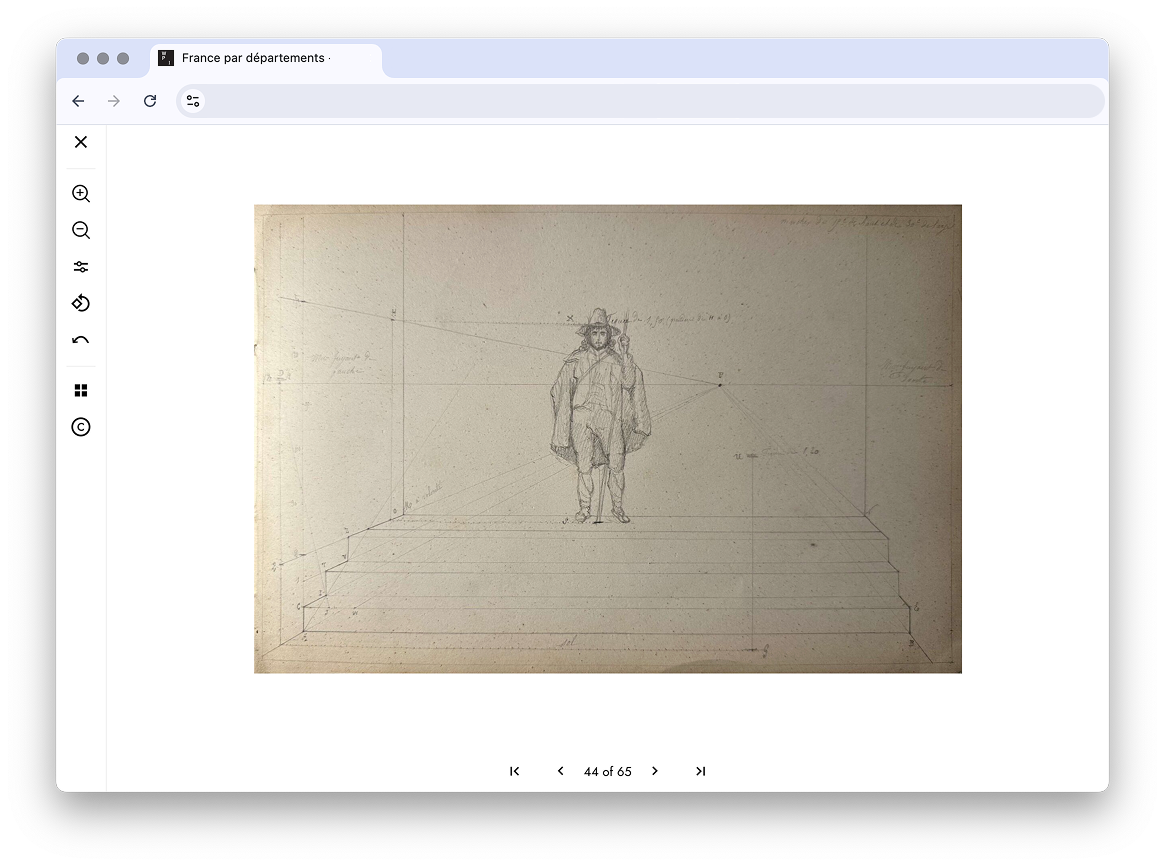
Eva Gonzalès, France par départements, c. 1860-65. Pencil, ink, and watercolor on paper. Private collection.
She began her professional artistic training at sixteen with the portraitist Charles Chaplin, a fashionable painter known for his idealized depictions of women and children. She quickly grew dissatisfied with what she considered a conservative approach, one that prioritized decorative charm over substantive engagement with contemporary artistic developments. Yet even within these constraints, Gonzalès was already seeking her own path.
La Demoiselle, painted around 1866–68 while still partially under Chaplin's instruction, reveals an artist testing the boundaries of her training. The small oil on canvas, later mounted on cardboard, depicts a young woman in a white gown seated against a loosely rendered dark background. While the subject matter of a demure female figure aligns with Chaplin's preferred repertoire, Gonzalès's handling suggests an emerging independence: the brushwork carries a directness that resists the porcelain smoothness typical of her teacher's manner, and the sitter's gaze, though averted, possesses a psychological reserve that elevates the composition beyond mere prettiness. The work stands as evidence of an artist already in transition, absorbing academic technique while straining toward a painterly freedom.
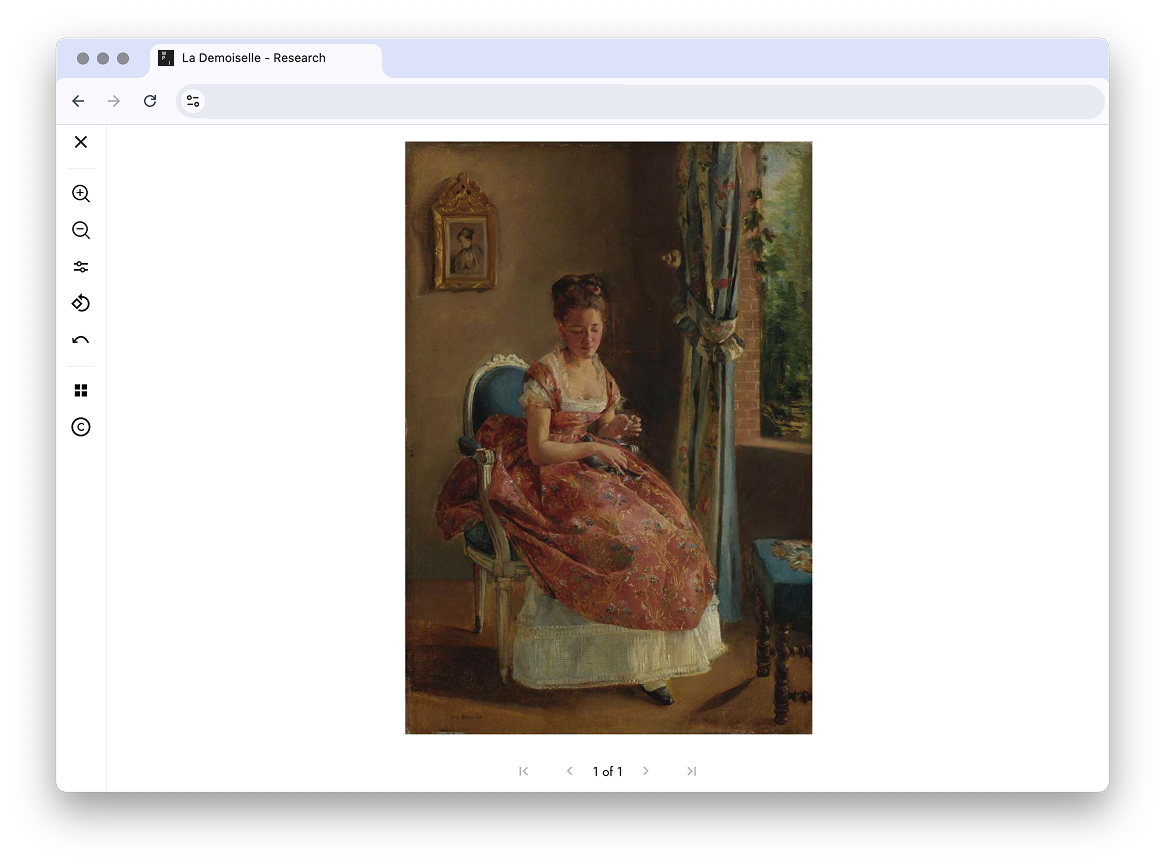
Eva Gonzalès, La Demoiselle, c. 1866-68. Oil on canvas, 40 x 27.5 cm. Private collection.
In February 1869, Gonzalès took a decisive step: she began sitting for a portrait by Édouard Manet and brought him her work for discussion. She would now learn from him directly rather than from his paintings alone. The impact was swift. At the 1870 Salon, she exhibited the oil painting Un enfant de troupe, which was immediately purchased by the French state as a signal of early official recognition. The work evinces her evolving practice, bridging the strict academic training of her years with Chaplin and a more modern, Impressionist-adjacent sensibility. A young military drummer stands isolated against a neutral background, his uniform rendered with careful attention to detail while the surrounding space flattens in a manner indebted to Manet's own simplifications. The painting invites direct comparison with Manet's Le Fifre of 1866: both works depict solitary young musicians against abstracted grounds, suppressing traditional modeling in favor of bold tonal contrasts. Yet Gonzalès's handling retains a softness and atmospheric subtlety distinct from Manet's more confrontational flatness, suggesting not imitation but dialogue. Like her teacher, she did not exhibit with the Impressionists, choosing instead to work within and reform the Salon system from the inside.

Eva Gonzalès, Un enfant de troupe, c. 1869. Oil on canvas, 130 x 98 cm. Musée de Gajac, Villeneuve-sur-Lot.
Working primarily in carefully staged studio settings, Gonzalès brought a refined touch and quiet luminosity to depictions of modern bourgeois experience. Her technique united the structural discipline of Realist painting with a sensitivity to atmosphere and surface, achieving psychological depth through understated gesture and tonal subtlety rather than dramatic effect. Her paintings reveal the people and places she could access most readily, highlighting commonalities in the female artist's experience in nineteenth-century France. Like Berthe Morisot and Mary Cassatt, she painted herself, her family, and domestic spaces. Her oeuvre is full of paintings of her sister Jeanne and her mother. Between 1869 and 1875, for example, she painted Portrait de Madame Emmanuel Gonzalès, mère de l'artiste, depicting her mother with soft, downturned eyes, holding bright red flowers, and wearing a cream ensemble. The composition balances intimacy with restraint: the figure emerges from a dark background, her face and hands illuminated with tender precision, while the loose handling of her dress and the vivid floral accent demonstrate Gonzalès's increasing confidence in modulating finish across a single canvas.
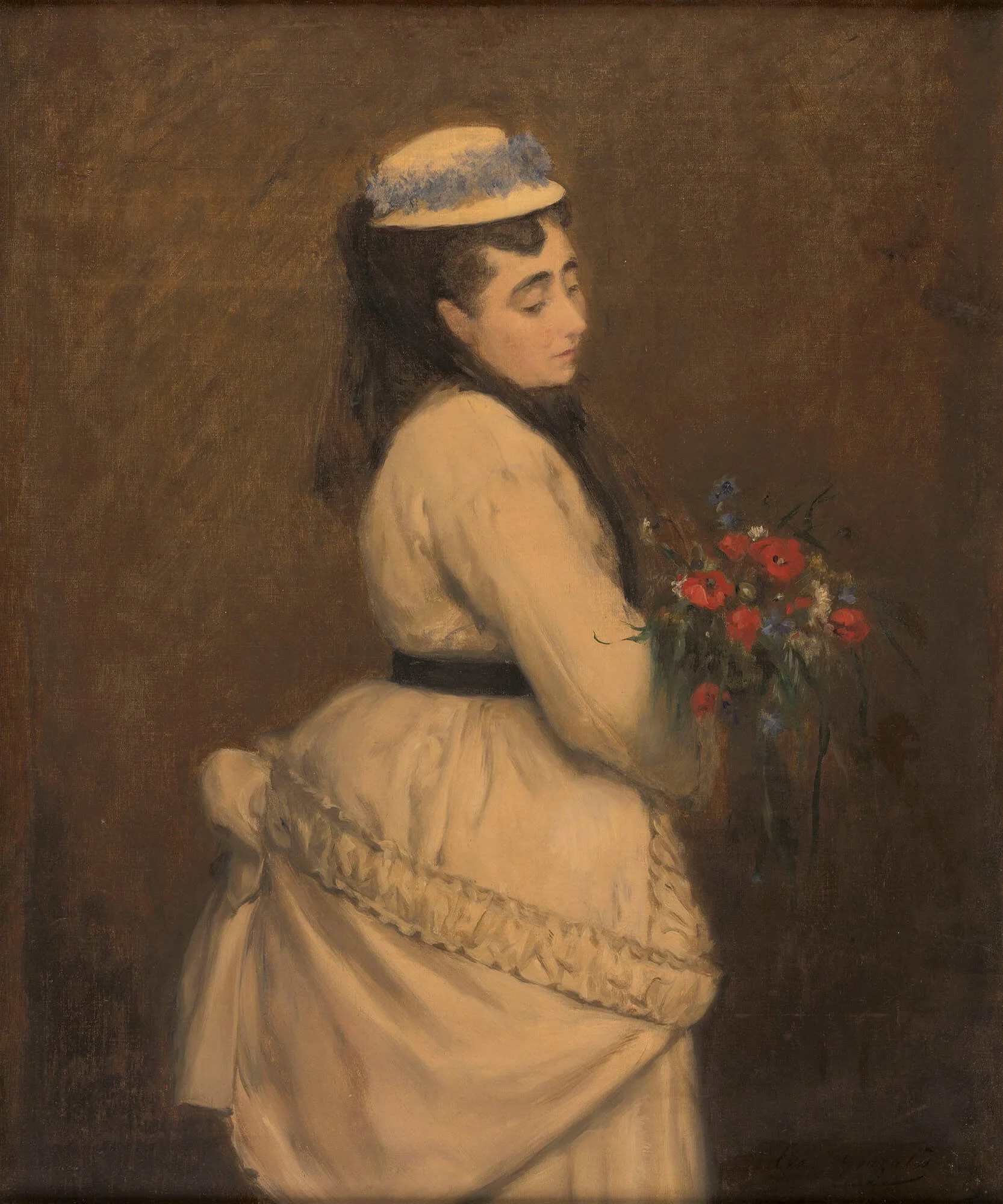
Eva Gonzalès, Portrait de Madame Emmanuel Gonzalès, mère de l'artiste, 1869–75. Oil on canvas, 55.8 x 46 cm. Public domain image from Ackland Art Museum, University of North Carolina at Chapel Hill.
Gonzalès is often remembered as Manet's pupil and as the sitter for one of his most peculiar portraits, but her career cannot be reduced to this association. By 1872, she had begun working in a more independent style, and by 1877, the distance had grown sufficiently that Manet remarked in a letter that she had ceased seeking his guidance. She consistently received favorable notice from critics, among them Émile Zola and the feminist writer Maria Deraismes.
In her later years, Gonzalès increasingly turned to pastels, a medium that allowed her to explore chromatic abstraction and the optical effects of layered color. Sous le berceau, Honfleur, from 1880, exemplifies this direction: beneath a canopy of foliage rendered in strokes of green, blue, and violet, a figure reclines in dappled light, the boundaries between form and atmosphere softened by the medium's inherent luminosity. Griselda Pollock and other feminist art historians have examined the gendered associations of pastels in this period—their perceived "femininity," their domestic scale—while also tracing the strategic ways in which women artists like Gonzalès, Morisot, and Cassatt navigated male-dominated institutions and markets. That these artists were largely written out of the canonical history of French painting until recent decades speaks not to any deficiency in their work but to the scholarly and institutional biases this catalogue raisonné seeks to redress.
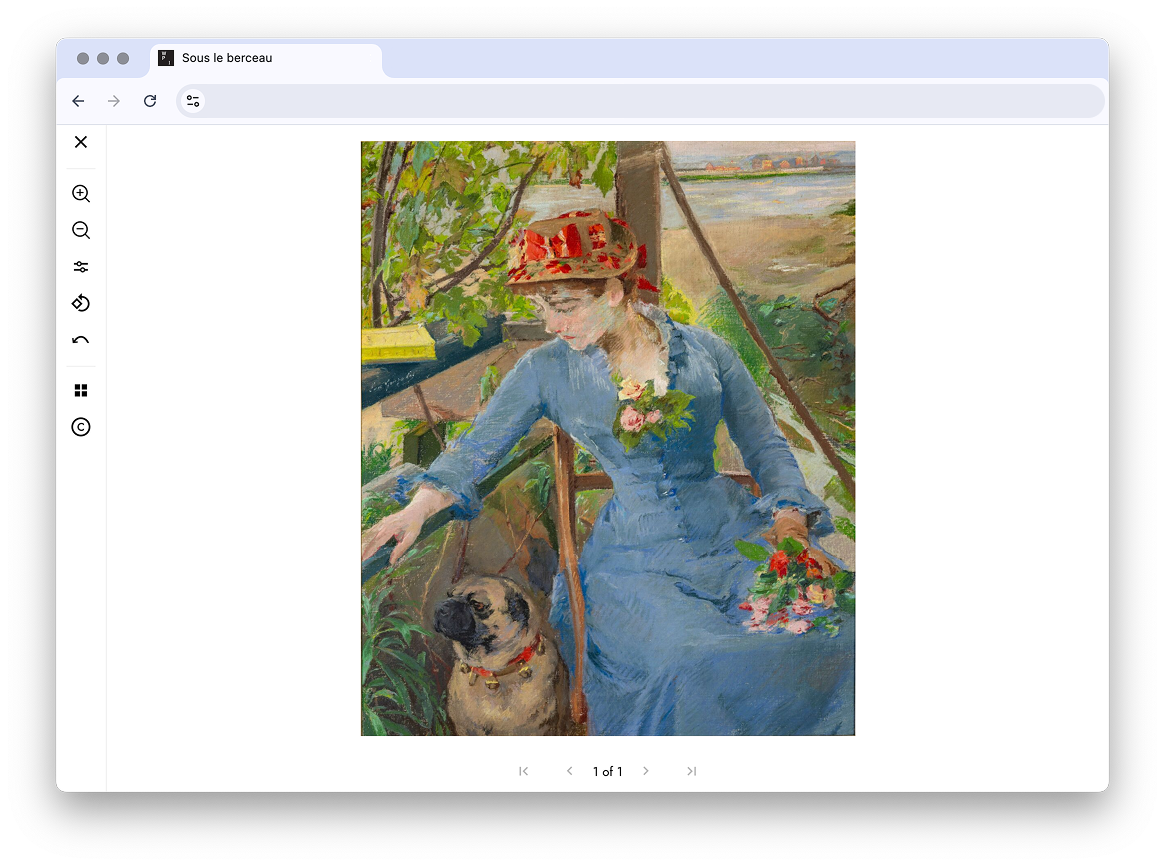
Eva Gonzalès, Sous le berceau, Honfleur, 1880. Pastel on canvas, 48 x 36 cm. Académie des sciences morales et politiques, Paris.
Correcting history and working to rectify erasure
Creating a catalogue raisonné for a female artist like Gonzalès illuminates the systemic documentation challenges facing what Griselda Pollock has termed "nonwhitemale" artists. When work began on the first Gonzalès catalogue in the 1980s, scholars confronted a near-total absence of foundational literature: only a slim volume published by Claude-Roger Marx in 1950 existed, despite the regular exhibition of her work in France between 1885 and 1985. This scholarly lacuna was not incidental but structural, rooted in the very mechanisms through which nineteenth-century artists entered the historical record.
Chief among these mechanisms was the dealer system. Male artists of Gonzalès's generation—Manet with Durand-Ruel, Monet with both Durand-Ruel and later Bernheim-Jeune, Degas with his carefully cultivated network of marchands and collectors—benefited from commercial relationships that generated systematic documentation: stock books, correspondence archives, photographic inventories, and exhibition records. These materials have proven indispensable to subsequent scholarship. Gonzalès, by contrast, operated largely outside this infrastructure, selling works through personal networks and the Salon system, which left a far more fragmentary archival trail.
Her circumstances compounded these challenges. Gonzalès died at thirty-four, just five days after giving birth to her son Jean-Raymond and mere days after Manet's own death, truncating the possibility of a sustained late career that might have attracted dealer attention or generated additional documentation. The subsequent dispersal of her estate introduced further confusion: her sister Jeanne married her widower, the engraver Henri Guérard, leading to the conflation of works and records between the sisters, husband, and son. These entangled histories underscore precisely why the systematic research undertaken for this catalogue raisonné is essential: reconstructing through painstaking archival work what the commercial art world's record-keeping mechanisms failed to capture for women artists of Gonzalès's era.
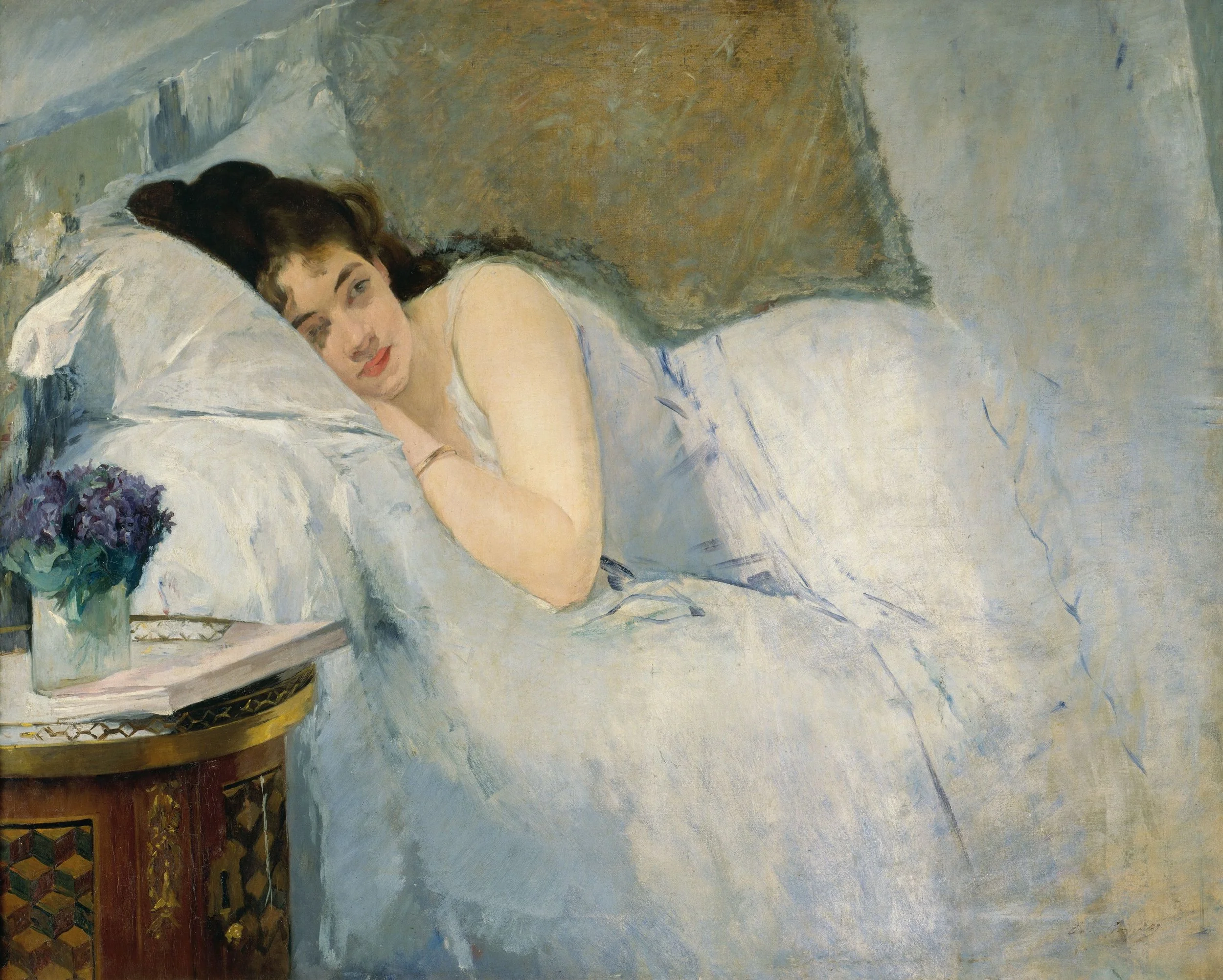
Eva Gonzalès, Le Réveil, c. 1877-78. Oil on canvas, 81.1 x 100.1 cm. Public domain image from Kunsthalle Bremen - Der Kunstverein in Bremen.
Going deeper using digital infrastructure
The digital infrastructure of this catalogue raisonné works to address these documentary challenges. As with all WPI catalogues raisonnés, the Eva Gonzalès publication displays methodological transparency and prioritizes accessibility using digital possibilities. The WPI publishes findings as they become available rather than waiting until all research is complete, allowing scholars and the public to engage with the most current state of knowledge while further investigation continues. Visual cues communicate the status of each work with clarity. Users will find black-and-white images for works yet to be fully examined and full-color images for those vetted and confirmed for inclusion, each accompanied by complete cataloguing details. This system renders the scholarly process visible, inviting users to understand not only what has been established but also where questions remain open. The platform's search and filter functions enable researchers to navigate the oeuvre by date, medium, dimensions, provenance, exhibition history, or current location, facilitating comparative studies and new lines of inquiry that would require laborious cross-referencing in a printed volume.
The digital format of this catalogue raisonné also allows for a depth of provenance documentation that traditional print publications cannot easily accommodate. Rather than presenting ownership histories as bare chronological lists, the platform employs interactive dialog boxes that reveal the archival evidence and reasoning behind provenance determinations. This apparatus proves especially valuable in cases where the documentary record is fragmentary or ambiguous, which arise somewhat frequently in Gonzalès scholarship, given the tangled histories of her estate. Consider Le Réveil, a painting that passed to her widower Henri Guérard upon her death in 1883. When a user hovers over the first provenance line, a dialog opens to explain that the work may be identified with one of two paintings listed in Guérard's inventaire après décès, taken on May 24, 1897, at 4 avenue Frochot: "2ème chambre à coucher . . . Peinture par Mme Eva Gonzalès ('Le Coucher') prisée cinq francs . . . Jeune femme couchée, peinture par Mme Eva Gonzalès, prisée huit francs." The dialog further notes that the lender recorded in the 1885 exhibition catalogue appears as "Ch. Gérard"—likely a misspelling of "Guérard"—and explains how these entries, cross-referenced with the posthumous inventory, support the conclusion that the painting was inherited by the artist's widower. Such explanatory layers transform provenance from a static list into a transparent scholarly argument, allowing researchers to evaluate the evidence and pursue further inquiry.
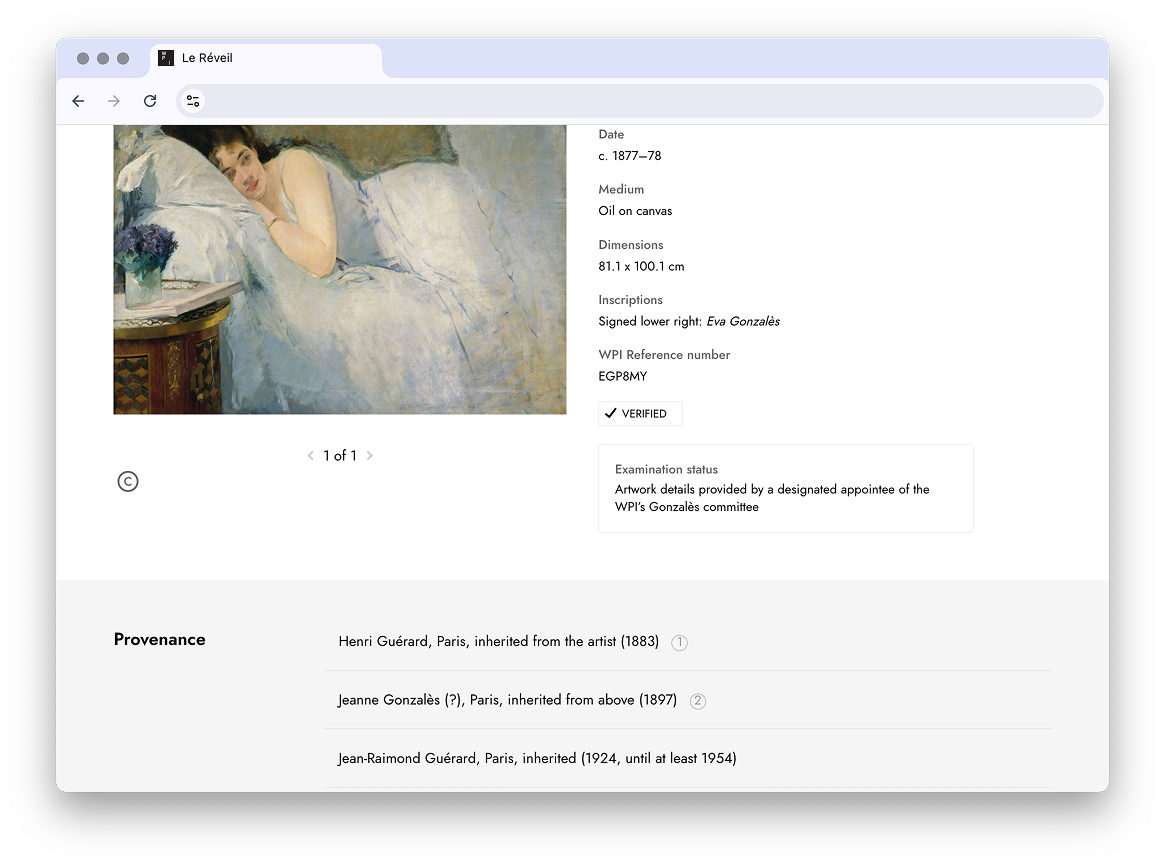
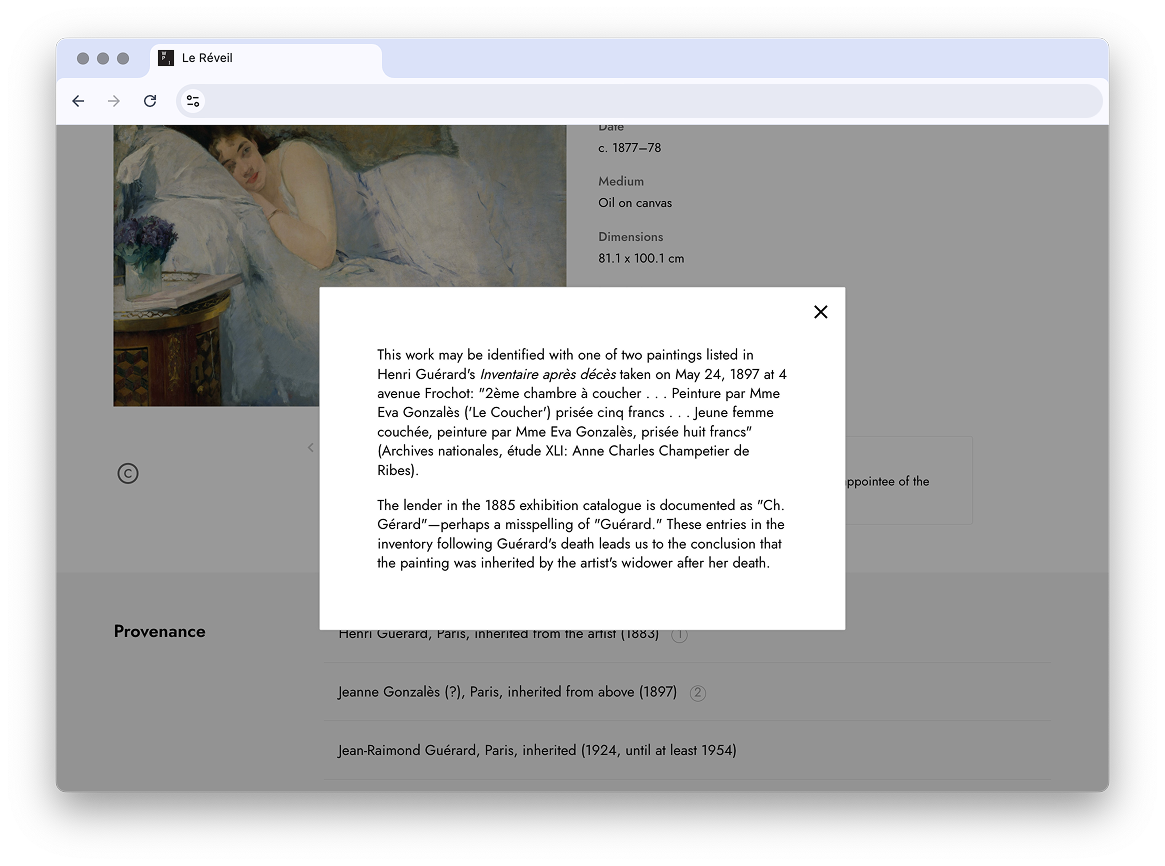
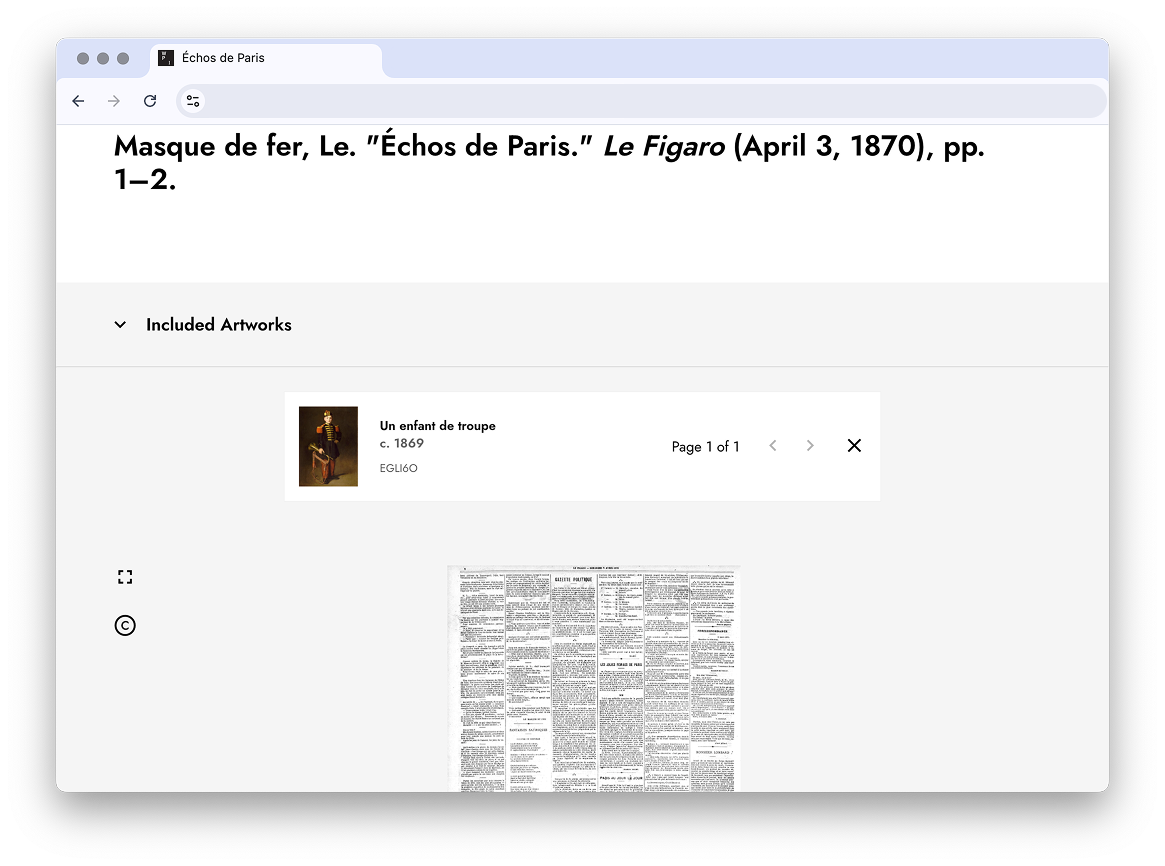
The catalogue raisonné also integrates digitized primary sources that illuminate Gonzalès's critical reception. For works exhibited publicly, the platform compiles references from period journals and newspapers, providing researchers with immediate access to the contemporary discourse surrounding her paintings. The entry for Un enfant de troupe, shown at the Salon of 1870 and purchased by the French state, exemplifies this resource: sixteen separate mentions from that year alone are documented, and digital copies of each are accessible directly from the artwork record, sourced through Gallica, the Bibliothèque nationale de France's digitization initiative. Scholars can thus move seamlessly from the painting itself to the full range of critical responses it provoked, tracing how reviewers positioned Gonzalès within the artistic debates of her moment. This integration of primary reception history not only simplifies research but also underscores the extent to which Gonzalès was a visible and discussed presence in the Parisian art world, countering narratives of obscurity that have too often characterized accounts of women artists from this period.
Eva Gonzalès Digital Catalogue Raisonné: A foundation for future scholarship
The release of the Eva Gonzalès Digital Catalogue Raisonné represents not an endpoint but a foundation for continued scholarly engagement with this significant artist. The WPI anticipates that by making this comprehensive body of research freely accessible to a global audience, it will stimulate new avenues of inquiry into Gonzalès's oeuvre, her position within nineteenth-century French artistic networks, and broader questions surrounding the recovery of women artists from historical obscurity. As additional works emerge from private collections, as provenance research deepens, and as scholars bring fresh methodological perspectives to bear on her paintings, pastels, and drawings, the digital format allows for ongoing refinement and expansion.
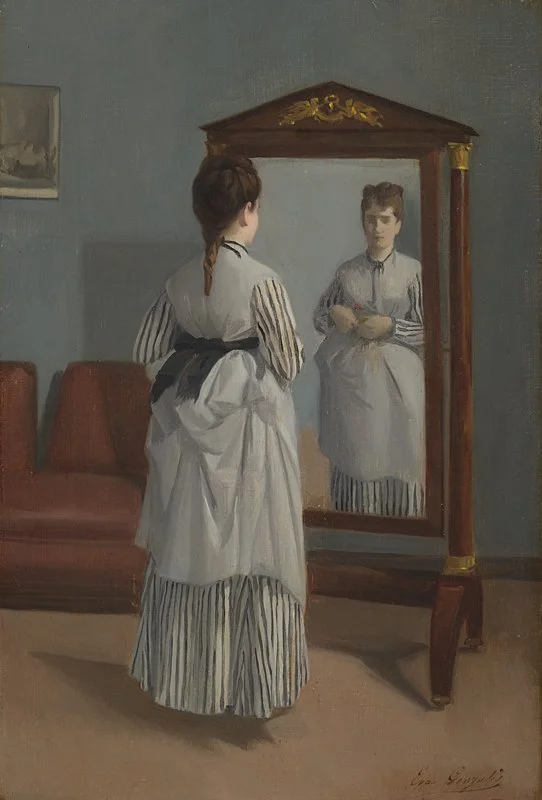
Eva Gonzalès, La Psyché, c. 1868-69. Oil on canvas, 39 x 26.5 cm. National Gallery, London. Licensed for non-commercial use under Creative Commons.