Highlights from the Catalogue Raisonné Scholars Association and College Art Association 2026
The 2026 annual meeting of the College Art Association (CAA) included a sustained meditation on access, technology, and the future of art history. Across sessions on the catalogue raisonné and digital art history, presenters returned to a set of intertwined questions: Who—or what—gets access? What counts as knowledge? How do digital infrastructures, artificial intelligence, and embodied experience reshape our objects, methods, conclusions, and modes of dissemination? And what does preservation mean in a born-digital world?
This overview traces four major strands of conversation: the evolving ecosystem of catalogues raisonnés; the challenge and promise of artificial intelligence; the reframing of accessibility; and, as a focal example, the “Seeing Cézanne Anew” panels, which demonstrated how technical research, archival recovery, digital dissemination, and new theoretical approaches converge to advance the field of art history.
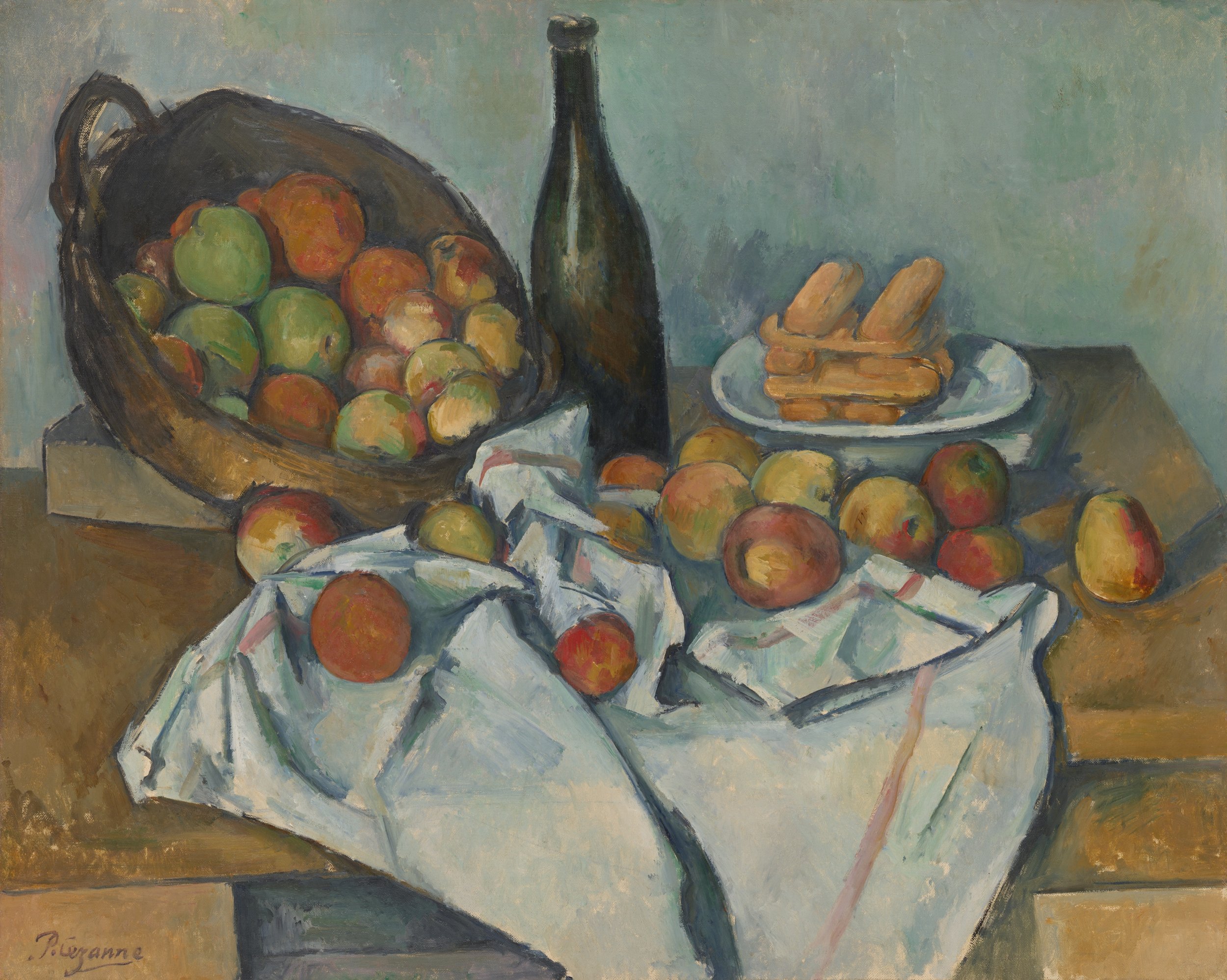
Paul Cezanne, Basket of Apples, c. 1893. Oil on canvas, 65 × 80 cm. Art Institute of Chicago. Image in the public domain.
Definitions, ecosystems, and preservation of the born-digital at the CRSA panel, “We are living in a digital world, and this is a digital catalogue raisonné”
One question surfaced repeatedly in discussions at the Catalogue Raisonné Scholars Association panel: What is a catalogue raisonné now? Is it a definitive list, or a platform for further documentation? Does it function primarily as an authentication mechanism, a scholarly resource, a public-facing form of engagement, or a preservation challenge? The answers that emerged were open-ended acknowledgments that the contemporary catalogue raisonné occupies these roles simultaneously—and the tension among them defines the present moment.
Digital catalogues raisonnés presented at the panel foreground access rather than completion, distancing themselves from a traditional feature of a catalogue raisonné. Liz Neely and Barbara B. Lynes from the Georgia O'Keeffe Museum and Caitlin Sweeney from the Wildenstein Plattner Institute presented catalogue raisonné projects that operate as research infrastructures designed to grow over time and for broad, sustained use.
Neely, curator of digital experience, and Lynes, author and consultant, explained in their presentation, “Reimagining Georgia O’Keeffe: Catalogue Raisonné for the Digital Age,” that the Georgia O’Keeffe Museum based its approach to the forthcoming digital catalogue raisonné project on the museum’s values: mission-driven, audience-centered, and forward-looking. Rather than replicating the 1999 printed volumes in digital form, the project emphasizes transparency of evidence, linking provenance claims to archival documentation and making visible differences of scholarly opinion. Interoperability through standards such as Linked Art and IIIF allows the data to circulate beyond the museum’s own interface, while user tools, including downloadable datasets, customizable lists, and filtering mechanisms, encourage active engagement rather than passive consultation.
The digital corpus model presented by Caitlin Sweeney, senior director of digital strategy and publications at Wildenstein Plattner Institute, in her presentation “Beyond the printed page: The production and impact of digital catalogues raisonnés,” continued this emphasis on access over tradition. Defined lists still matter; the intellectual rigor of establishing a corpus remains central. Yet publication at the WPI is increasingly iterative. Projects adopt agile workflows, refine internal style guides over time, and incorporate FAIR data principles and controlled vocabularies such as those developed by the Getty. Answers to questions about how to represent competing claims, how to track the provenance of data itself, and how to update entries without erasing scholarly history bind art historical expertise and a conception of digital tools as scholarly infrastructure. The catalogue raisonné becomes less a finished object and more a continuously maintained knowledge system.
The shift in language alone signals a conceptual realignment. The Georgia O’Keeffe Museum refers to its project as Access O’Keeffe, keeping the term “catalogue raisonné” in deeper layers of the project for scholars but relying on a more general title to benefit a wider audience. Sweeney explained that the WPI uses terms such as “digital catalogue raisonné project” and “digital corpus” rather than “catalogue raisonné.”
These developments have profound implications for the concept of authority. Historically, inclusion in a printed catalogue raisonné often functioned as de facto authentication. The boundary between scholarly inclusion and market validation was porous, and the printed page conveyed finality. However, in digital environments, authority shifts from pronouncement to documentation and inclusion–expressly not authentication—is determined and accompanied by archival discoveries, conservation findings, and other forms of visible evidence. Digital platforms indicate the possibility of future augmentation by making it possible to layer time-stamped knowledge and present conflicting research without overwriting earlier conclusions. The result is a model of cumulative scholarship in which inclusion is reframed as a process grounded in transparency rather than a singular act of declaration. This recalibration affects not only scholarship but also the legal and commercial ecosystems that have long relied on catalogues raisonnés as arbiters of authenticity.
The long tail and preservation as generative work
The first phase of a catalogue raisonné has typically been seen as the labor-intensive work of research and publication, but Anne Helmreich, director of the Archives of American Art, made clear that digital catalogues raisonnés complicate this picture. In her presentation, "The long tail of the digital catalogue raisonné," Helmreich argued that the second phase—the "long tail"—may be even more demanding, given the significant and unanswered questions around data maintenance and enabling continued use. It is possible to preserve screenshots or static export captures of a digital catalogue raisonné, much like archiving a book, but this records only the surface to the exclusion of the underlying data structures that give digital catalogues raisonnés their power as research tools. Prioritizing the data and its relationships as the essence of a digital catalogue raisonné introduces a new set of responsibilities. Digital catalogues require ongoing migration as software evolves and standards shift. Proprietary platforms raise concerns about long-term accessibility and control. And institutions must decide who is responsible for maintaining relational databases, funding updates, and training born-digital archivists capable of stewarding these complex systems.
Helmreich notes that this preservation can be seen as generative work, meaning that maintenance actually requires creation: formats must be updated, data exported and re-ingested, and interfaces redesigned to account for technological decay and progress. While challenging, this sustained interaction opens and reopens avenues of inquiry into the research itself. Sustainability planning is therefore not ancillary but foundational to preservation and future, yet unimagined forms of scholarship.
Material research, new methods, and digital cataloguing: The Cezanne model
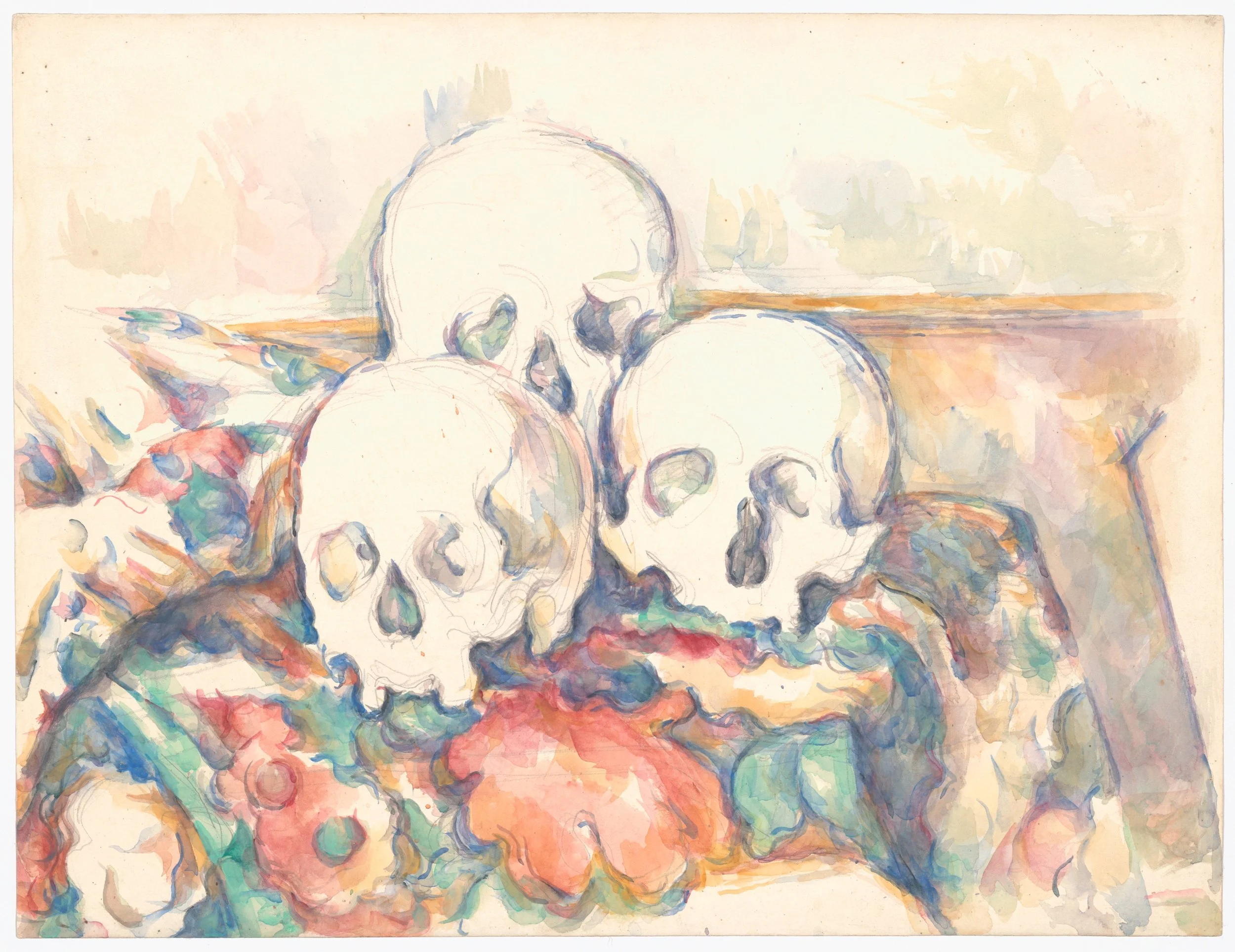
Paul Cezanne, The Three Skulls, 1902/1906. Watercolor with graphite on ivory wove paper, 48 × 62.8 cm. Art Institute of Chicago. Image in the public domain.
The panel “Seeing Cézanne Anew” exemplified how careful material research and digital dissemination create a rich research environment for new investigations into a beloved artist. Scholars discussed the Art Institute of Chicago’s digital publication Cezanne Paintings and Watercolors at the Art Institute of Chicago and Société Paul Cezanne’s The Paintings, Watercolors, and Drawings of Paul Cezanne, as well as new research building on these fundamental resources.
Kim Muir and Giovanni Verri at the Art Institute of Chicago presented an iterative program of technical research on Cezanne’s paintings and watercolors, now disseminated through an extensive digital publication. High-resolution imaging, infrared reflectography, and pigment analysis reveal that seemingly “flat” backgrounds are in fact complex amalgamations of color mixtures; interfaces between figure and ground disclose preparatory drawing and compositional revision. The digital format enables zoomable images, layered documentation, and integrated conservation histories—particular benefits of the digital medium that allow technical research to be integrated and thoroughly presented rather than summarized.
Michela Bassu, member of the Société Paul Cezanne, shared research associated with her PhD dissertation, Cézanne. Son art, son œuvre: birth of a catalogue raisonné and a critical reception, tracing the creation of the first comprehensive catalogue raisonné of Paul Cezanne’s work in 1936 to the Société Paul Cezanne online catalogue raisonné. Compiled by the art historian Lionello Venturi, the original catalogue raisonné was based on meticulous study of extensive archival materials, including photographs, correspondences, manuscript and typescript notes, exhibition catalogues, and bibliographic notes, now preserved in 17 envelopes in the Lionello Venturi Archive. These resources allowed Venturi to establish a systematic and authoritative record of Cezanne’s paintings and works on paper, providing a foundational reference for later scholars. The current online catalogue raisonné, which integrates Venturi’s scholarship with subsequent catalogues, digital color imagery, advanced search capabilities, and regularly updated information, ensures the continued advancement of Cezanne research for scholars, curators, collectors, and the general public.
Three scholars presented arguments that recover aspects of Cezanne and his works yet to be seen. Fabienne Ruppen, speaking from the Kunstmuseum Basel, demonstrated how close material study of Cezanne’s watercolors at the Art Institute of Chicago—supports, fading pigments, and parallel experimentation with oils—reconstructs not only what works looked like originally but how they were made. Nancy Locke re-situated Cezanne’s repeated drawings after Puget within questions of provincial identity and artistic solidarity. C.C. McKee’s reading of The Negro Scipion reframed temporality and representation through Black studies and philosophies of the event. The lesson was clear in this panel: the catalogue raisonné is now a nexus linking conservation science, archival recovery, interpretive debate, and digital dissemination. It is not simply a record of works but a layered presentation of research processes
Digital art history, artificial intelligence, and the catalogue raisonné
Artificial intelligence formed a thread throughout CAA 2026 that intersected with conversations about data and access relevant to digital catalogue raisonné projects. This was nowhere more evident than in the panel “What Difference Does AI Make?”
Mark Olson, Julia McHugh, and Julianne Miao from the Nasher Museum of Art at Duke University recounted their 2022–23 experiment, “Act as if you are a curator: an AI-generated exhibition,” held in the museum’s incubation gallery. Prompted to propose an exhibition, ChatGPT-3.5 selected the theme “Dreams of Tomorrow: Utopian and Dystopian Vision,” the works to include in it, as well as the wall text to support it. As an exhibition, it was definitely not successful. ChatGPT-3.5 identified plausible objects but renamed works, fabricated details, and produced labels riddled with errors. It proposed lighting and architectural changes beyond feasibility. But the exhibition was a helpful learning experience for the institution, students, and visitors. And this learning was only possible because it happened within the context of expertise. The museum’s staff knew how to evaluate the outputs and included corrected wall labels, explanatory texts, and educational programs. The team explained that the exhibition functioned less as a curatorial triumph than as a conversation starter, attracting global press and exposing anxieties about authority, authorship, and institutional responsibility within an institution dedicated to education.
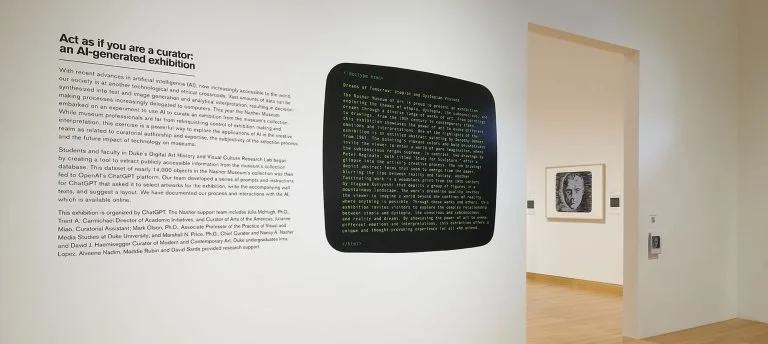
Installation view of Act as if you are a curator – an AI-generated exhibition, September 09, 2023 – February 18, 2024. Nasher Museum of Art at Duke University, North Carolina.
Emily Pugh of the Getty Research Institute argued that “digital art history” may be at a rhetorical low point not because of artificial intelligence per se but because the field lacks shared language, curricula, bibliographies, and conceptual clarity about computational technologies. She persuasively argued that the dichotomy “art versus technology” risks rendering art obsolete by definition—and a false definition at that. Instead, she urged specificity: art historians must develop nuanced vocabularies for computing, beyond generic digital enthusiasm or alarm.
Alison Langmead, professor at the University of Pittsburgh, proposed that “AI makes no difference at all”—meaning that historians have been at the forefront of technological change and, indeed, used it to advance the field and explore new methodologies for understanding art and its contexts. We’ve made great use of photography, slide libraries, and digital imaging as these technologies have become available; artificial intelligence is no more than another available tool. AI cannot think, it cannot imagine, it cannot hallucinate, it cannot feel. It is not the future because it can only remix the past. The work of historians is to understand the present while shaping the future, tasks that AI cannot compute.
Across this and other sessions, contributors presented aspects of artificial intelligence with specificity and described it collectively less as an existential threat than as a diagnostic tool: AI reveals the assumptions embedded in our data, the fragility of our vocabularies, and the institutional responsibilities attached to technological adoption.
The digital catalogue raisonné as critical infrastructure
CAA 2026 suggested that art history operates—as it always has—amid reconfiguration; catalogues raisonnés are becoming interoperable, iterative, and accessible ecosystems to support that ongoing evolution. Perhaps the most striking commonality was a refusal of simple binaries—digital versus analog, art versus technology, presence versus absence. Instead, presenters across the conference called for specificity, infrastructural literacy, and long-term stewardship. If there was an undercurrent of anxiety about funding, preservation, disciplinary, or identity, it was matched by a pragmatic optimism: syllabi can be written; models can be interrogated; archives can be re-read; and digital tools can be built responsibly.
For scholars engaged in building and sustaining digital catalogues raisonnés, the conference offered encouragement. The challenges are substantial: sustainability, interoperability, migration, and epistemological clarity demand sustained effort. Yet the opportunities are equally significant. Digital catalogues riasonnés can integrate conservation science, archival depth, and user engagement in ways that print never allowed. The future of the catalogue raisonné will depend not simply on digitization, but on the rigor with which we define authority, structure data, design interfaces, and commit to long-term stewardship.