Advancing free scholarly access to art historical research materials: announcing the WPI Digital Library
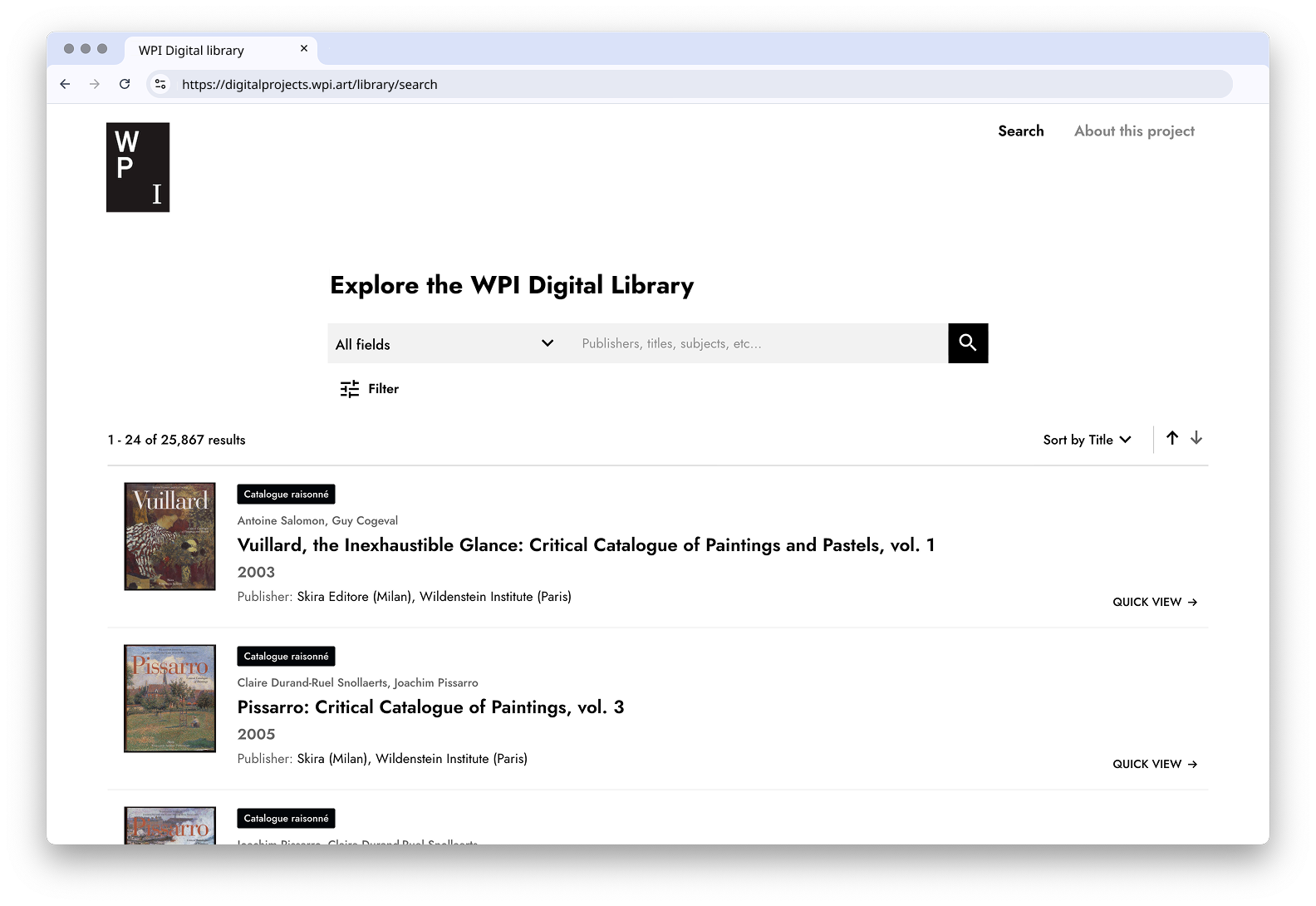
The WPI Digital Library advances scholarly access to art historical resources. Launching with over 25,000 scanned publications, this new platform consolidates the Wildenstein Plattner Institute's extensive collection of sales catalogues, exhibition catalogues, and catalogues raisonnés into a single, searchable location. Navigating.art designed the Digital Library technology with two primary values in mind: usability and findability. By integrating enhanced search capabilities with an intuitive design, the Digital Library addresses researchers' needs while opening new avenues for discovering connections across the art market and exhibition histories.
"The Wildenstein Plattner Institute possesses an extraordinary collection of materials, and our objective has been to disseminate and share these knowledge resources with the public rather than restrict access," says Samantha Rowe, senior archivist and manager of digital archival projects at the WPI. "We aim to make them available for research, consultation, and scholarly enjoyment." And this is only the beginning.
A comprehensive collection
The Digital Library brings together a substantial collection of materials focusing on paintings, drawings, sculpture, and prints by European artists active from the 18th through the 20th century. The collection features over 24,000 historical sales catalogues dating from the 17th century to 1945, originating from major international auction houses across Western Europe and the United States. As primary sources, these catalogues are valuable to researchers studying provenance, art market trends, and the evolving reception of artists over time. Many include handwritten annotations, including prices and buyers' names, that offer additional insights into historical transactions.
While the Digital Library primarily replaces the previous sales catalogues database with an improved experience, the exhibition catalogues represent new content, not previously accessible in this format. The collection includes 972 exhibition catalogues documenting exhibitions held at the Wildenstein Gallery from 1911 to 2012. These span the Wildensteins' gallery locations in Paris, New York, Tokyo, Buenos Aires, and London, as well as exhibitions organized with international partner institutions in Houston, Lima, Johannesburg, and beyond. This collection helps trace the impact of the Wildenstein Gallery on the international art market. Additionally, the digital library features 47 artists' monographs, catalogues raisonnés, and books published by the Wildenstein Institute between 1919 and 2013, produced in collaboration with international presses such as La Bibliothèque des Arts, Taschen, and Skira. These works cover a range of French artists, with a particular emphasis on 18th- and 19th-century art.
This unified approach allows scholars to search across auction and exhibition records simultaneously, enabling them to trace artwork and artists across different contexts and make connections that were previously difficult or time-consuming to establish.
Usability: researcher-centered design
The Digital Library prioritizes transparency and ease of use throughout the research process. In an effort to make as many resources as possible accessible to the public, the Digital Library includes publications with varying levels of descriptive metadata, with some publications appearing before cataloguing is complete. The interface clearly displays what information is present and what is missing in each record, allowing researchers to make informed decisions about the completeness of their sources. As cataloging work continues, data and metadata will be updated and expanded. This transparency reflects the internal work undertaken by WPI's research team to ensure publication records are as complete as possible.
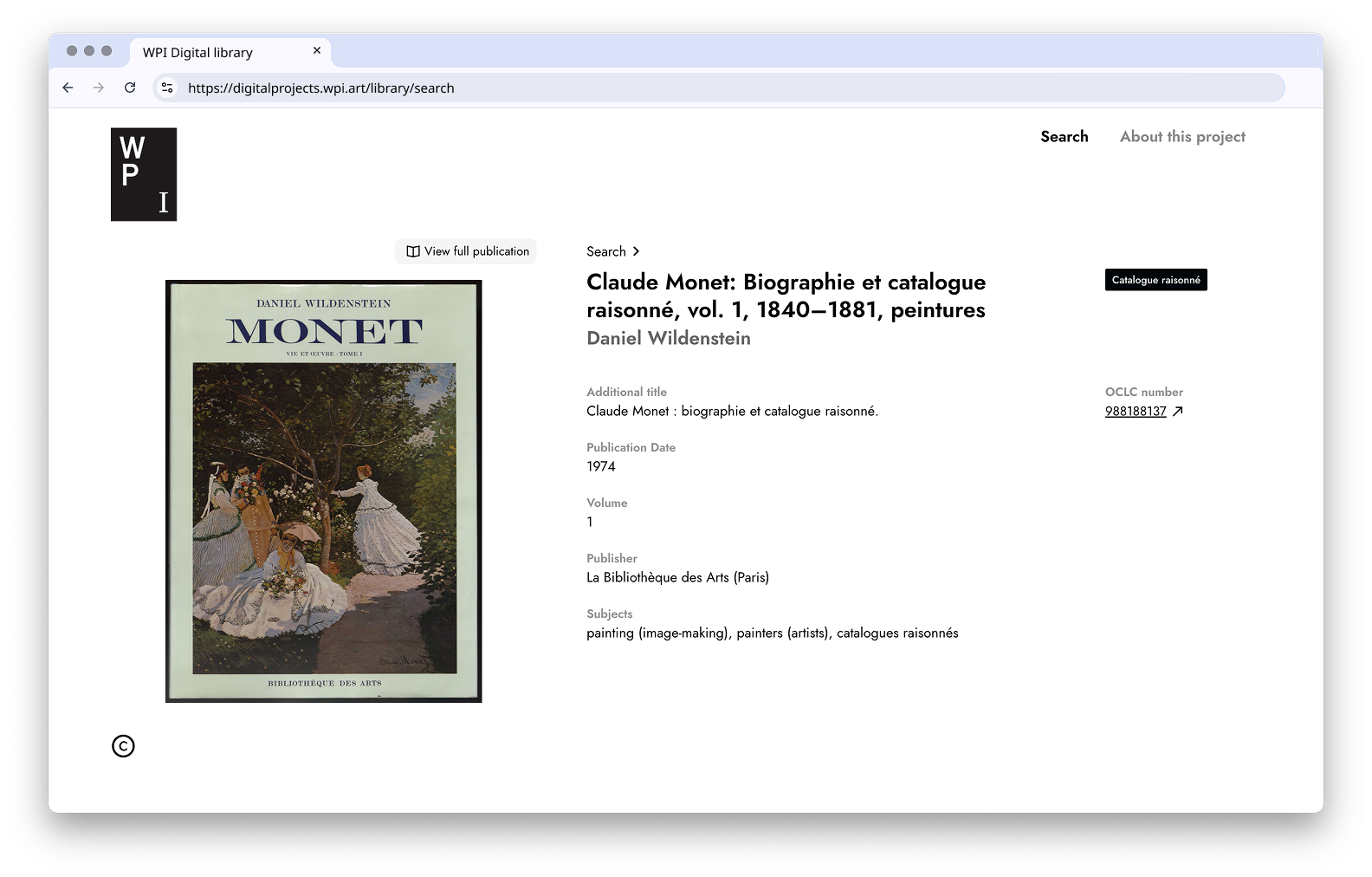
Consistency across the platform also supports usability. The Digital Library employs the same controlled vocabularies used throughout the Navigating.art platform and catalogues raisonnés published on it, including the Art & Architecture Thesaurus (AAT) for subjects, the Union List of Artist Names (ULAN) for person names, and the Getty Thesaurus of Geographic Names (TGN) for locations to create high-quality bibliographic records. This standardization ensures that researchers familiar with other WPI projects can navigate the digital library with ease.
The Digital Library extends its reach beyond the WPI website to major scholarly platforms. Through membership in OCLC (Online Computer Library Center), the WPI has more than 8,000 bibliographic records in WorldCat, the world's largest library catalog, with ongoing work to expand coverage. These records help researchers worldwide discover WPI's resources while providing links back to the full digital content on the WPI website. The sales catalogue collection also appears in SCIPIO (Sales Catalogs Index Project Input Online), a specialized database for auction catalogues that requires an institutional subscription but offers additional metadata and discovery options for researchers at subscribing institutions. Additionally, the WPI contributes unique, institution-created records to the Getty Research Portal, where approximately 7,851 WPI sales catalogue records are currently available, each linking directly to the full publication on the WPI website. This multi-platform approach ensures that researchers can discover WPI's materials through multiple entry points while always maintaining free, direct access to the complete digitized publications.
Findability: powerful search and filtering
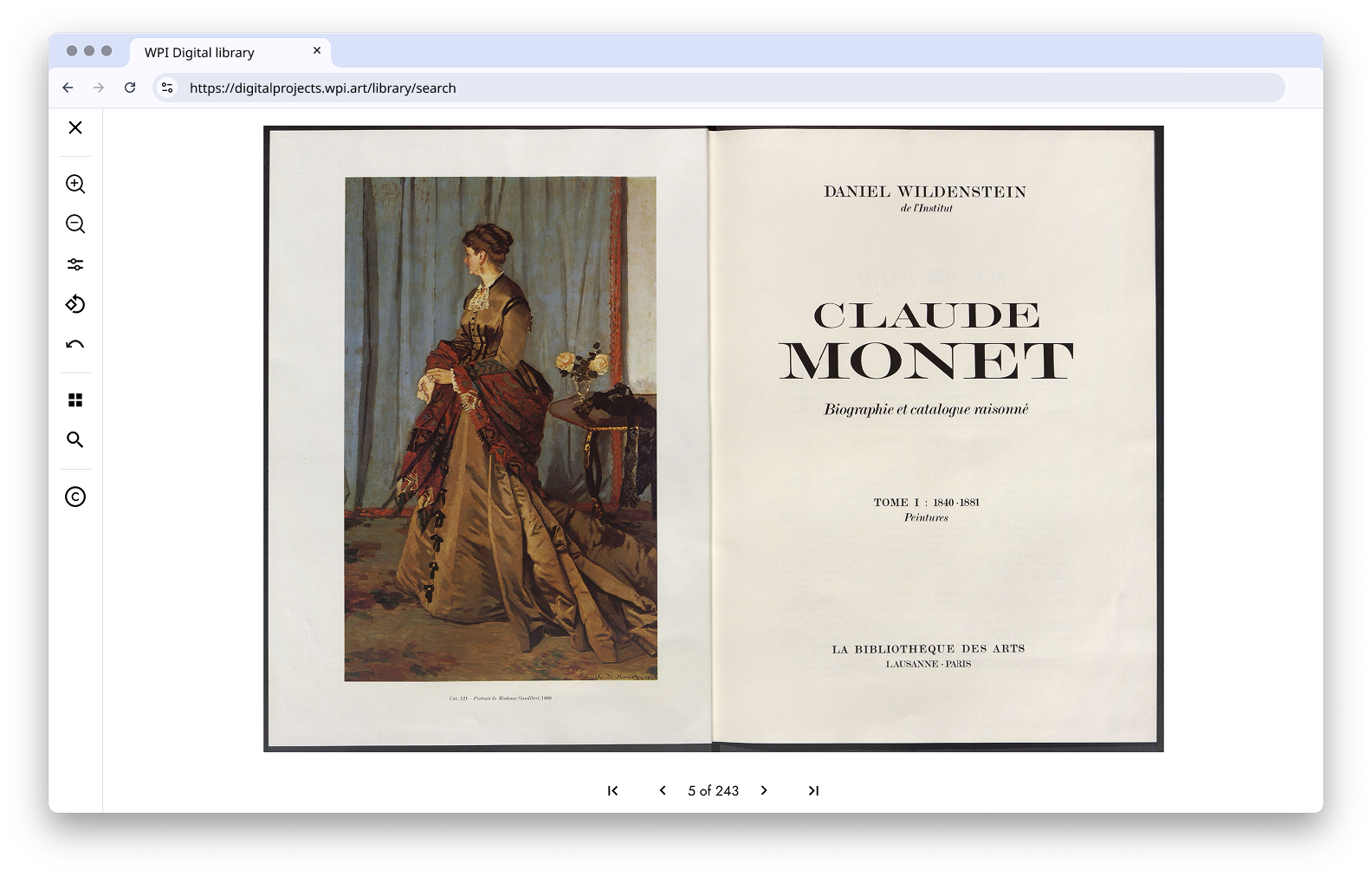
At the heart of the digital library's research value lies its search and filtering capabilities. An improved optical character recognition (OCR) pipeline enables full-text searching across all publications, with the system capable of recognizing and processing text in multiple Latin-script languages. The team reprocessed one million images for the launch of the Digital Library to ensure accurate text capture and localization on each page. Lisa Weiß, product lead at Navigating.art, explains: "The digital library leverages all of our previous learnings from WPI's search experiences to create a truly useful tool for researchers. The full-text search capability is particularly valuable because it highlights search terms directly within the scanned documents, significantly reducing the effort required to navigate frequently small text."
Researchers can search for publications by title, author, publisher, or subject in the main search bar. To search the text of a publication, users can select "Full text (OCR)" from the drop-down menu, which highlights matching terms directly within scanned documents and allows scholars to identify where their terms of interest appear within lengthy publications.
Beyond simple keyword matching, the digital library employs relevance scoring. Rather than merely counting matched pages, the algorithm considers multiple factors, including the number of matches per image and the proximity of search terms to one another. Search results clearly indicate the number of matches found within each document and can be sorted by title, author, type, date, and relevance, in either ascending or descending order. This allows researchers to assess the depth of relevant content before opening a publication.
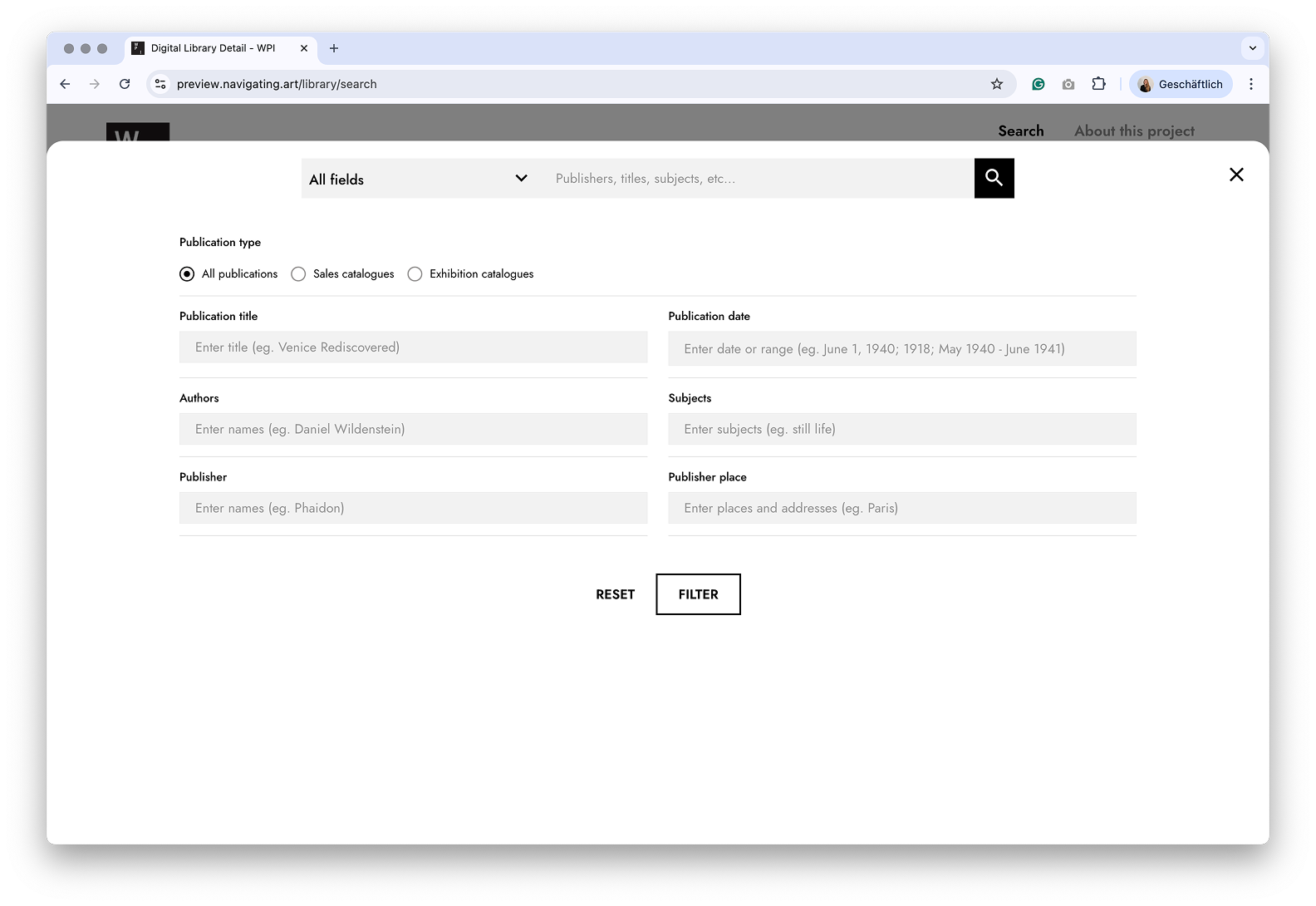
The platform's filtering capabilities address researchers' concerns about receiving too many results or lacking sufficient refinement options. The advanced search allows users to filter by publication type, with the default searching all publications and enabling refinement by publication title, publication date, authors, subjects, publisher, and publishing location. Multiple authors, subjects, publishers, and publication locations can be entered into the respective fields to create highly specific searches.
Filters allow searching based on specific events such as auctions or exhibitions. When users filter by sales catalogues, additional fields appear for auction-specific details, including auction date, auction house, and auction location. Similarly, filtering by exhibition catalogues enables searches using exhibition title, exhibition date, exhibition venue, and exhibition location. All filters can be combined with full-text search, enabling researchers to achieve extreme precision when navigating the extensive publication collection. This level of specificity was considered necessary for the digital library to serve advanced scholarly needs effectively.
Future expansion: toward greater interconnectivity
The current launch represents the first phase of the digital library's development. The digital library will actively expand its holdings as the WPI continues to identify and prepare additional resources that are in the public domain, including books, exhibition catalogues, periodicals, artists' monographs, and catalogues raisonnés. This expansion involves reviewing existing public domain resources to determine what can be shared publicly, checking publication data and scan quality before release. This work will proceed in phased batches throughout 2026, progressively expanding access to WPI's holdings.
Several planned feature enhancements will further increase the platform's research utility and interconnectivity with other WPI resources. Isabel Flores, project manager for the Digital Library at Navigating.art, emphasized this vision: "Our ultimate goal is to achieve even greater interconnectivity within the platform. We envision enabling the integration of the mentioned artwork from cataloging projects, making auction details clickable, and allowing users to explore related publications by clicking on subjects or publishers, thereby facilitating new research connections and discoveries."
Mission-aligned digital innovation
The Digital Library advances both the mission of the WPI and the broader goals of Navigating.art. What began as discussions about future possibilities has now materialized as a comprehensive platform that brings together sales catalogues, exhibition records, and other publications in a single, freely accessible location—reflecting the WPI's core belief that art historical knowledge and primary sources should serve the broader scholarly community rather than remain restricted to those with physical proximity to specialized libraries or the means to pay for databases.
Martin Lorenz, managing director at Navigating.art, celebrates this mission-aligned achievement: "This project exemplifies our approach to building research infrastructure that truly serves scholars' needs. The Digital Library demonstrates how new technologies can connect dispersed resources and enhance transparency in art historical research. The platform enables researchers to ask new questions and discover previously hidden connections." The combination of comprehensive content, intuitive usability, and effective findability tools creates a powerful resource for art historical scholarship.
As the Digital Library continues to expand and integrate more deeply with other WPI projects, it will further strengthen the infrastructure supporting art historical research, making primary sources accessible to scholars worldwide and supporting new lines of inquiry into the circulation, exhibition, and reception of art. In doing so, it contributes to a broader vision of connecting cultural heritage resources across databases, archives, books, and collections throughout the globe.